

Every woman killed by a man who chose to steal her life and her future leaves behind grief, anger and questions that can never be answered. But even in that grief, we must try to resist the temptation to believe that nothing we do makes a difference. The evidence tells us otherwise.
Over the past 35 years, the rate at which women are killed in Australia has fallen by more than half. There is still much more work to do, and every woman killed is one too many, but that long-term progress reminds us that violence is not inevitable. It can be prevented.
Women* are still being killed
Recognising that we've made progress in preventing gendered violence does not diminish the tragedy of the women and children who have been killed, usually by men who claimed to love them. Their deaths are not inevitable, they reflect the devastating consequences of gendered violence that persists despite important gains in prevention, and reforms in response.
Every one of those women and children leaves behind a hole in the world, a place where they should have lived and remained parts of their communities. A place where all the people who loved them and everyone whose lives they would have touched will now just have grief and absence.
When the news of several violent murders breaks in a short period, it can feel as though the problem is getting worse rather than better. The headlines are relentless. The sense of despair can be overwhelming. It is entirely appropriate to grieve for those women, to be outraged by the injustice done to them and to demand better from our society, from all of us, in creating violence-free futures. But if we start to believe that prevention doesn't work – that nothing works – we risk abandoning the very efforts that have already saved lives.
Recognising that we’ve made progress in preventing gendered violence over the years can feel insignificant, even offensive in the wake of another woman killed by another man who should never have been able to make that choice. Yes, we might have saved lives, but we didn’t save this life, this woman, this child. Knowing these killings are preventable is precisely why they provoke such profound grief and such justified anger.
Hope, though, is not the opposite of grief. It is what allows us to keep working through grief.
Recognising progress means holding on to hope
The National Homicide Monitoring Program has tracked every homicide in Australia since 1989–90. The data shows that women are most likely to be killed by a male family member or intimate partner and men are most likely to be killed by a male acquaintance.
When we look at what’s happened in Australia over the last 35 years, the trend is unmistakable: the rate at which women are killed has fallen by more than half since 1989-90.
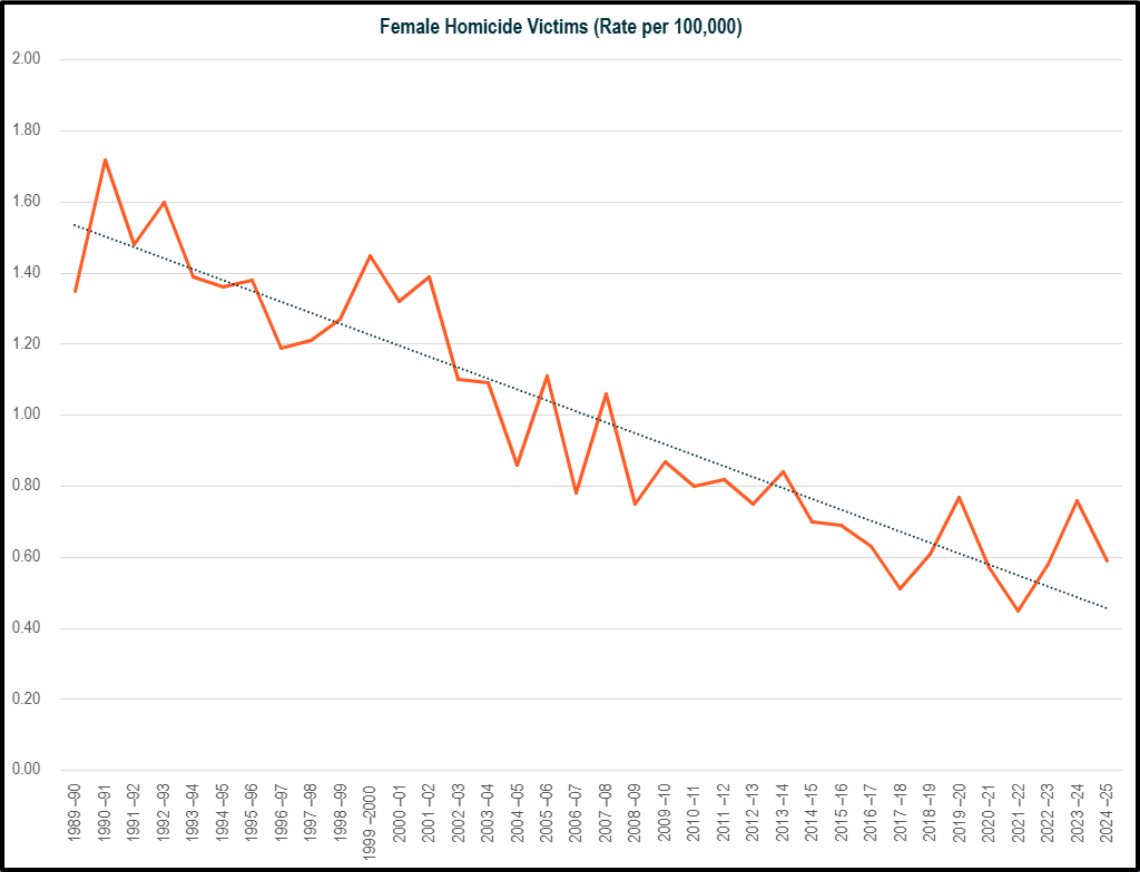
The decline has not been smooth. Some years are lower than the year before; others are higher. Homicide is, thankfully, a relatively rare event and a small increase or decrease in the numbers can produce a substantial change in the annual rate.
Researchers are cautious about drawing conclusions from one or two years of data. Short-term movements can be driven by chance, individual incidents or circumstances that don't represent broader social change. It is often impossible to identify a single reason why the homicide rate rose one year and fell the next.
Long-term trends are different.
When a pattern continues over decades, it becomes much more likely that something meaningful has happened. The long-term trend in Australia is clear. Women today are considerably less likely to be killed than they were 35 years ago.
That decline did not happen by chance. It reflects decades of sustained and increasing work to prevent violence, support victim-survivors and hold people who use violence to account.
This tells us that fatal violence against women is not inevitable. We can change it because we have changed it.
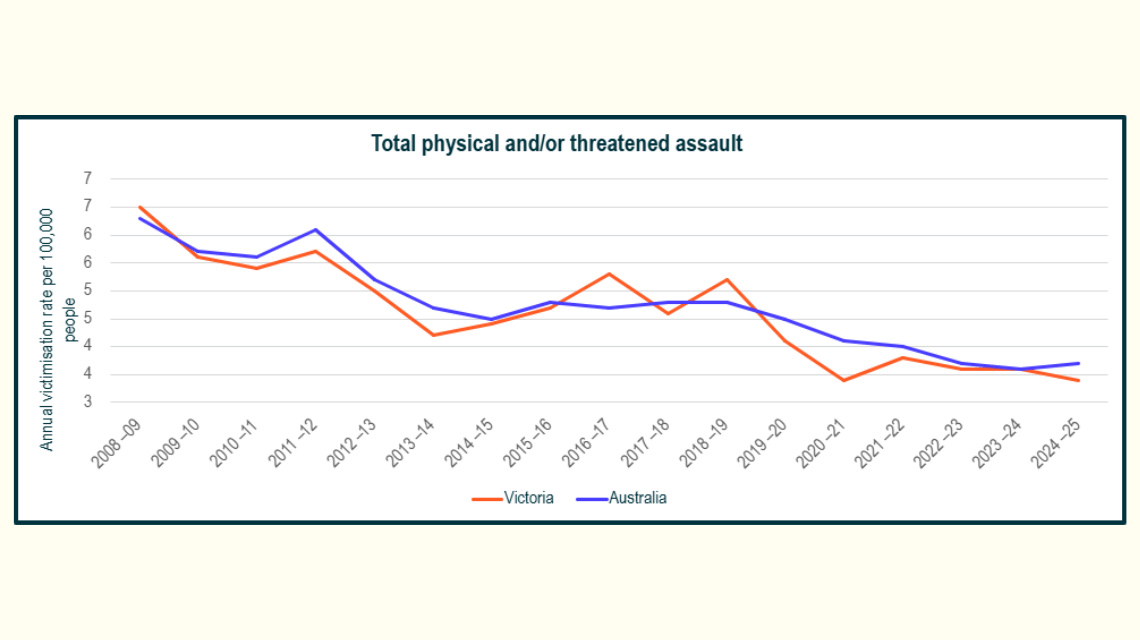
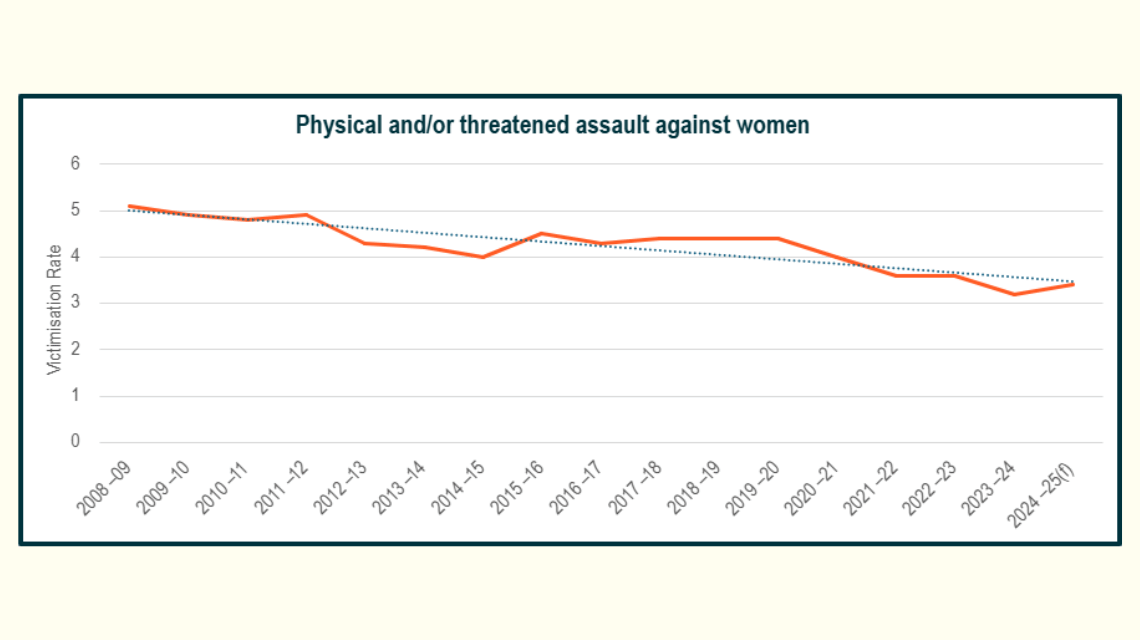
It’s also worth remembering that homicide is the rarest and most extreme expression of men's violence against women. If there are forces preventing women from being killed, it’s likely those same forces are preventing many more women from experiencing non-fatal violence. Data from the Australian Bureau of Statistics Crime Victimisation Survey suggests the rate of physical assaults against women has trended downward over the last fifteen years.
What has been working?
There is no single reform, program or policy that can explain a movement of this magnitude.
Lasting social change rarely occurs because of one intervention. It happens because thousands of actions reinforce one another over many years. Legal definitions shift. Public understanding of violence improves. Expectations within families and communities evolve. People become more willing to speak out. Institutions become better at recognising risk. Governments invest in prevention and response. Children are taught healthier ideas about respectful relationships, violence and gender and take these ideas into all their relationships.
Attitudes influence behaviour, but behaviour also shapes attitudes. As more positive beliefs about gender and relationships become more common, they reinforce new ways of thinking and behaving until they become the social norm. This can make it easier for people to identify and respond to signs of violent or controlling behaviour. Changes like this take time, consistency and commitment across every part of society.
Over the past three decades, Australia has invested in specialist responses to family violence, including crisis helplines, refuges, counselling, financial and legal assistance, and increasingly coordinated responses across police, courts, health, local government and community services. There has been greater recognition of the needs of children and young people who experience family violence, alongside growing investment in services designed by and for First Nations women, people with disabilities, migrant and refugee communities, LGBTQIA+ communities and others whose experiences have too often been overlooked. There has also been increasing attention to programs that work with boys, men and others who use violence, recognising that preventing violence requires changing the behaviour of those who perpetrate it as well as supporting those who experience it.
Prevention work in schools, sporting clubs and communities, particularly through local municipalities and governments, is where the seeds of changed beliefs and behaviour start to grow. The National Community Attitudes Survey has been monitoring Australians’ attitudes and beliefs around gender equality and violence against women for many years and the results show our understanding and rejection of gendered violence and gender inequality have improved significantly since 2009, with Victoria consistently showing results slightly above the national average.
This correlates with data from the Australian Bureau of Statistics that shows the rate of assault in Victoria is lower than the national average.
We cannot say that any one of these initiatives caused the decline in women's homicide. Social change is rarely that simple. But neither should we ignore what the evidence shows. Over the same period that Australia strengthened prevention, support services, legal responses and public awareness and education, the rate at which women were killed fell dramatically. The evidence is consistent with the conclusion that sustained, long-term effort has helped make women safer.
The work is far from finished. Women and children are still being killed. Families are still grieving. Communities are still demanding change. But the evidence tells us that prevention is not wishful thinking. It saves lives.
In this series, we will explore the many ways people, communities and governments can continue building on that progress. We will examine what research tells us about preventing violence before it starts, responding effectively when it does occur, supporting victim-survivors to rebuild their lives, and working with those who use violence to reduce the risk of future harm.
Because the most important lesson from the last 35 years is not that we've solved the problem – we haven’t – but we have learned that prevention is effective and together we can make a difference. And we should never lose sight of that.
This is the first in a series about addressing violence in Victoria in collaboration with writer and prevention expert, Jane Gilmore. Sign up to our newsletter to make sure you get the latest instalments delivered to your inbox. Find more from Jane on Substack.
* While this first article focuses on women – a category that includes cisgender and trans women – we acknowledge that people of all genders experience family, sexual and other forms of violence, including fatal violence. No matter the gender of the victim, these harms are predominantly perpetrated by cisgender men. We will continue to explore these patterns as part of this series.