

The First Action Plan established strong foundations for achieving the objectives of the National Plan through significant policy development, evidence generation and reform. It delivered major national milestones including Our Ways – Strong Ways – Our Voices: National Aboriginal and Torres Strait Islander Family Safety Plan, the Rapid Review of Prevention Approaches, Working for Women: A Strategy for Gender Equality for Gender Equality, the National Higher Education Code to Prevent and Respond to Gender-based Violence and the Australian Law Reform Commission’s Inquiry into Justice Responses to Sexual Violence. Importantly, it also created the conditions for jurisdictions to strengthen their own family violence policy frameworks, governance arrangements and implementation approaches.
Collectively, these reforms have driven significant activity across jurisdictions. They have paved the way for a more strategic, coordinated and long-term approach to investment that prioritises strong system infrastructure and sustained implementation. The Second Action Plan should now focus on strengthening, embedding and scaling what works.
The following section outlines a set of evidence-based principles that should guide the design and implementation of the Second Action Plan. Together, they provide a framework for ensuring that prevention efforts across every jurisdiction remain grounded in the evidence, coordinated across the family violence continuum and are scaled to achieve lasting, population level change.
1.1 Maintain an evidence-based approach to primary prevention
Primary prevention focuses on stopping violence before it starts by changing the conditions that allow it to happen in the first place. It addresses the attitudes, social norms, practices, structures and power imbalances that influence individual behaviour.
The Second Action Plan should continue to position gender inequality that arises from gender-discriminatory institutional, social and economic structures, social and cultural norms, and organisational, community, family and relationship practices as the primary driver of family violence, violence against women and all forms of gendered violence.
Primary prevention activities under the Second Action Plan should also continue to be informed by Australia’s shared national framework for the prevention of violence against women, Change the story, as well as other complementary frameworks such as:
- Changing the picture which sets out specific drivers of violence against Aboriginal women
- Changing the landscape which sets out drivers and reinforcing factors of violence against women with disability (11)
- Changing with pride (forthcoming) which sets out the drivers and reinforcing factors of violence against LGBTIQA+ people.
These frameworks, built on decades of research, clearly articulate the specific drivers of gendered violence and the corresponding actions and settings required to address them (11). They are regularly reviewed and updated in line with the evidence base and are crucial to an effective and intersectional approach that recognises and addresses the shared and unique drivers of violence, oppression and discrimination on the basis of gender, race, Aboriginality, disability, age, class and sexuality. These frameworks are further supported by an increasingly sophisticated body of implementation and practice evidence and guidance, including on gender-transformative practice, recognising that effective primary prevention requires approaches that actively transform the gendered norms, roles, power relations and systems that drive violence, rather than simply acknowledging or raising awareness of them (12).
A comprehensive approach to primary prevention requires action to address both the underlying gendered drivers of violence and the reinforcing factors that can increase the likelihood, frequency or severity of violence – such as alcohol and drug abuse, prior exposure to violence in childhood and broader social inequalities (11). However, addressing the gendered drivers and addressing specific reinforcing factors often require distinct, tailored efforts and expertise to be effective. It is therefore important not to conflate the two categories of work.
Factors such as alcohol misuse, exposure to violence and broader social inequalities can exacerbate violence, but they do not alone drive violence; targeting them in isolation from addressing the underlying gendered drivers will fail to produce the long-term sustainable change required to bring down rates of violence and keep them down over time. Understanding and distinguishing between the primary drivers of gendered violence and the ‘reinforcing factors’ or ‘risk factors’ will ensure policy and investment remain focused on the primary drivers of violence while also supporting, complementary action to address the factors that can increase or exacerbate existing threats of violence (11).
The Second Action Plan should continue to apply the established evidence base articulated in Change the Story while recognising that experiences of violence and opportunities to prevent, intervene and respond differ across life stages, settings and population groups. A life course approach provides an important framework to strengthen this work by helping to identify where the gendered drivers of violence emerge, how they are reinforced over time, and where interventions can have the greatest impact. A life course approach is further discussed at Section 1.4.
Recommendation 1
Maintain a clear focus on gender inequality as the primary driver of gendered violence while recognising the intersecting forms of discrimination and inequality that shape the prevalence and experience of violence across different communities. This should include:
- Ensuring primary prevention activities funded through the National Plan are grounded in Australia’s evidence base on the gendered drivers of violence and are gender transformative in their design and implementation
- Applying an intersectional approach that recognises how gender inequality interacts with factors such as racism, ableism, age, sexuality and socioeconomic inequality to shape experiences of violence, safety and respect
- Maintaining a clear distinction between the gendered drivers of violence and the reinforcing factors that can increase harm, to ensure each receives appropriate policy attention and investment, consistent with Australia’s primary prevention evidence
- Supporting a whole-of-government approach that advances gender equality through complementary reforms across health, education, employment, housing, justice, digital and social policy.
1.2 Invest in primary prevention at the scale required for long-term impact
Changing entrenched attitudes, social norms and behaviours that drive violence and permeate every part of our society, institutions and systems requires long-term, sustained and coordinated investment. Despite the profound harms and impact of gendered violence on Australian communities, current investment in primary prevention is not commensurate with the scale and complexity of gendered violence or the National Plan’s ambition to end violence against women and children within a generation.
The scale of this economic impact is substantial. (See the economic cost of violence against women and children below.)
The economic cost of violence against women and children
$21.7 billion
Estimated annual cost of violence against women and children in Australia
$10.4 billion
Estimated annual cost of pain, suffering and premature mortality associated with violence against women and children in Australia
$1.9 billion
Lost workforce productivity
$1.4 billion
Health system costs (13)
Importantly, the estimates above are widely recognised as conservative. They pre-date recent increases in reported gendered violence and do not adequately capture under reported or unreported violence including violence experienced by First Nations women, women with disability, pregnant women and women experiencing homelessness. KPMG estimated that accounting for violence experienced by these groups alone could increase the annual cost of violence against women by approximately $4 billion, highlighting that the true cost of gendered violence is likely to be considerably higher (13).
The economic case for increasing investment in primary prevention is compelling. Like other forms of prevention and health promotion, investing early to reduce risk before harm occurs delivers long-term social and economic benefits while reducing future demand for more intensive and costly interventions. The Australian Government has recognised this principle within the health portfolio, noting that every dollar invested in preventative health saves an estimate $14.30 in health care and other costs (14). The same principles applies when it comes to preventing violence. Well-resourced and effective primary prevention has the potential to reduce future demand for crisis response, policing, courts, health care, housing, child protection and other public services, while improving health, wellbeing, workforce participation and productivity (6). However, because these benefits are realised over longer timeframes and across multiple government portfolios, traditional funding approaches can systematically undervalue the potential impacts of primary prevention.
The Australian Government has invested over $4.4 billion under the National Plan since 2022, reflecting significant commitments across prevention, early intervention, response and recovery (15). However, while it remains difficult to quantify, the level of investment in primary prevention appears to have remained disproportionately low (16). Greater transparency and disaggregation of funding would help tell this story and ensure the National Plan can appropriately and adequately invest in primary prevention. Currently, funding is distributed across multiple Commonwealth and jurisdictional portfolios and service systems, with no consistent national framework for defining, tracking or reporting expenditure. This limits Commonwealth, state and territory governments’ ability to identify gaps, avoid duplication, strategically target funding and assess whether investment reflects the scale of need. Recognising this, the Domestic, Family and Sexual Violence Commission has recommended the development of a national funding mapping framework with agree definitions and consistent reporting of investment across the National Plan (17).
Respect Victoria notes that collaborative work to develop prevention strategies across the Commonwealth, state and territories under the First Action Plan remains ongoing (18). This work presents an important opportunity to substantially strengthen investment in primary prevention as part of the Second Action Plan, recognising that current funding levels are not commensurate with the scale of gendered violence or the human and economic costs it imposes. Increased investment will be essential to sustain and scale evidence-based prevention initiatives, strengthen prevention infrastructure and build workforce capacity and capability across Australia.
Future investment should also extend beyond the specialist prevention sector to support the integration of primary prevention across mainstream systems, including health, education, local government, justice and family law. This approach could effectively embed actions to address the gendered drivers of violence into the policies, decision-making processes, workforce practices, service provision and organisational cultures and policies of the institutions that shape people’s everyday lives. Doing so will help to ensure preventing violence becomes part of how these systems operate and mobilise them toward promoting gender equality and shifting the attitudes, norms and behaviours that drive gendered violence.
Alongside increased funding, maximising the impact of public investment also requires changes to how prevention is funded. True impact necessitates funding models that support the long-term, collaborative and systems-change focused nature of primary prevention. Considerations relating to funding design are discussed further in Part 3.
Recommendation 2
Increase investment in primary prevention under the Second Action Plan. This should include:
- A significant uplift in Commonwealth and state and territory investment to a level commensurate with the scale and impact of gendered violence
- Establish a nationally consistent approach to defining, mapping and reporting on investment in primary prevention to support decision-making, transparency, accountability and future planning
- Commissioning and publishing updated national estimates of the social and economic costs of violence against women and children to strengthen the evidence base for future policy and investment decisions.
1.3 Recognise the distinct roles of primary prevention and early intervention
The Second Action Plan should continue to recognise the distinct but complementary roles of primary prevention and early intervention. While both approaches are essential to achieving the objectives of the National Plan, they have different purposes, require different capabilities and should be supported through targeted policy, investment, workforce development and evaluation. Being clear about the different roles that primary prevention and early intervention fulfill is critical to ensuring both receive the distinct policy focus and investment required to respond to increasing demand.
Primary prevention works at the whole-of-population level and seeks to create the social conditions in which violence is less likely to occur by addressing the underlying drivers and strengthening the conditions that promote gender equality, respect and inclusion (11). Early intervention is further downstream; it seeks to identify and respond to emerging risks, behaviours and experiences of violence before they become entrenched – often working with individuals or groups who have already been identified as being at particular risk of experiencing or perpetrating violence (19). Both are critical components of a comprehensive approach to ending all forms of gendered violence and can only work effectively when implemented alongside high quality and well-resourced response, recovery and healing services.
Coordinating primary prevention and early intervention through a place-based approach
Designed by Respect Victoria, the place-based, primary prevention initiative Respect Ballarat demonstrates how primary prevention and early intervention can be intentionally resourced and coordinated while maintaining their distinct objectives. Recognising that pregnancy and the transition to parenthood are both a critical opportunity for prevention and a period of increased risk for gendered violence, the model brings together complementary interventions across the early years system.
Baby Makes 3, an evidence-based primary prevention program embedded in antenatal education and maternal and child health services, promotes gender equality, respectful relationships and equitable caregiving among all first-time parents within the program’s region (20). Alongside this, For Baby’s Sake provides targeted early intervention for expectant parents at risk of family violence, working intensively with both parents from pregnancy until the child’s second birthday to interrupt cycles of violence (21).
These initiatives are reinforced through broader early years prevention activity and dedicated local implementation support to build workforce capability, address barriers to uptake and identify opportunities for systems change. Together, they demonstrate how primary prevention and early intervention are most effective when they are coordinated, not conflated. Each has a distinct purpose, evidence base and target population, but when implemented effectively they reinforce consistent messages, strengthen referral pathways and improve outcomes for children and families across the continuum.
Primary prevention has not yet been funded at the scale and consistency required to achieve the objectives of the National Plan. It must remain a distinct pillar of the Second Action Plan to ensure it is not diluted or displaced by increasing demand for early intervention and response services and interventions. This requires both dedicated investment and activity alongside stronger integration of prevention across the family violence continuum. While primary prevention, early intervention, response and recovery are distinct pillars requiring different expertise and approaches, primary prevention provides a critical foundation for the broader system. Embedding an understanding of the gendered drivers of violence across schools, health services, community organisations, police and justice settings strengthens the quality of early intervention and response, challenges the attitudes and norms that excuse or condone violence, and supports the long-term systems change required to eliminate gendered violence (11).
Early intervention was identified in Maintain the Momentum, Respect Victoria’s 2025 Three Yearly Report to Parliament on the progress of prevention in Victoria, as a key gap in the Victorian family violence system requiring a stronger policy architecture, evidence base and level of investment to effectively respond to people at higher risk of using violence or demonstrating early signs of harmful behaviours (22). The Second Action Plan should retain a priority on primary prevention while also separately, increasing focus on early intervention as a standalone area for reform and investment to ensure opportunities to intervene before violence escalates are not missed.
Recommendation 3
Recognise primary prevention and early intervention as distinct but complementary and essential approaches to addressing domestic, family and sexual violence under the National Plan, ensuring activities under each pillar are appropriately designed, resourced, implemented and evaluated. This should include:
- Clearly articulating the distinct purposes, evidence-bases and intended outcomes of primary prevention and early intervention within the Second Action Plan
- Maintaining separate but aligned policy, funding implementation and evaluation frameworks that recognise the different objectives, target populations, workforces, professional skillsets and measures for success under each pillar
- Supporting coordinated implementation across the family violence continuum, ensuring primary prevention and early intervention reinforce one another through strong referral pathways and partnerships without conflating their roles
- Investing in implementation guidance and capability building to support governments and practitioners to apply these approaches consistently and with fidelity to the evidence base
- Promoting coordinated planning across Commonwealth, state and territory governments so that primary prevention and early intervention investment activity are mutually reinforcing.
1.3 Adopt a life course perspective to coordinate primary prevention activity
A life course perspective provides a strategic framework for targeting investment where prevention efforts can have the greatest and most enduring impact. It identifies key stages of life and developmental transitions where evidence indicates universal and targeted prevention interventions are most likely to influence attitudes, norm formation and risk and protective factors (23).
Preventing violence requires sustained, reinforcing action across the life course rather than one-off interventions. While universal, population-level approaches are essential, the primary prevention evidence base identifies a number of developmental stages or transition points that present critical opportunities to address the gendered drivers, when attitudes, beliefs, behaviours and social identities are being formed, reinforced or reshaped (23). These critical periods include early childhood, adolescence, pregnancy and the early stages of parenthood and later life (24).
A life course perspective enables more strategic and coordinated investment. It supports governments to align mutually reinforcing interventions across important settings to effectively reach large sections of the population at critical developmental stages. Applying a life course lens also assists prevention interventions to adapt and respond to the complex ways in which the gendered drivers of violence intersect with other forms of inequality over a person’s life, including racism, homophobia, ableism, transphobia and the ongoing impacts of colonisation on First Nations people (11).
A life course perspective helps to strengthen integration across the family violence continuum. It can identify periods where the risk of experiencing or using violence is heightened and where strengthened early intervention or response interventions may be particularly important, including for children exposed to family violence, young people displaying harmful sexual behaviours and following relationship separation (25). Aligning interventions across different stages of life helps to ensure people receive the right support at the right time while also recognising the distinct roles of specialist primary prevention, early intervention, response, recovery and healing approaches.
Applying a life course perspective to primary prevention activity planning
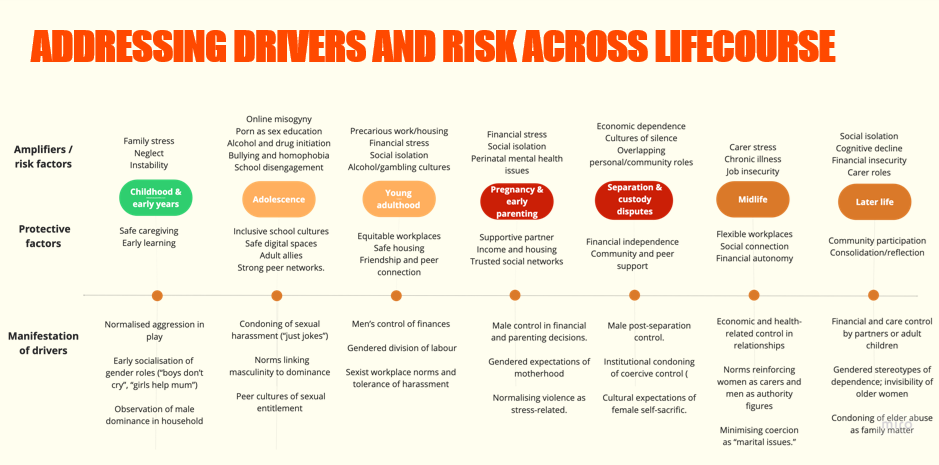
Respect Ballarat is a place-based primary prevention initiative, designed to strengthen coordinated action to prevent gendered violence across the Ballarat community. As part of the work to design the model, Respect Victoria developed a life course mapping exercise to demonstrate how the drivers of violence, and key risk and protective factors, emerge and interact across different stages of life and key developmental transition periods.
Rather than distributing primary prevention and early intervention activity evenly across the lifespan, this mapping tool identified key transition points, such as starting school, entering adolescence, forming intimate relationships and becoming a parent, where changing identities, relationships and social roles create important opportunities to strengthen protective factors and promote primary prevention principles.
The life course perspective provides a practical planning tool that Commonwealth, state and territory governments can use to identify where primary prevention effort is likely to have the greatest impact, strengthen universal primary prevention approaches at critical transition points, and better align primary prevention with complementary action across the continuum.
Recommendation 4
Embed a comprehensive, evidence-based life course perspective across all pillars of the Second Action Plan to ensure prevention, early intervention, response and recovery and healing activities are identified, prioritised and coordinated across key developmental stages and activated across systems and settings with greatest potential for impact.
1.4 Sustain and scale evidence-informed prevention approaches
The First Action Plan established important foundations for strengthening primary prevention across Australia. While prevention has long been recognised as an essential component of efforts to end gendered violence, it has never been funded at the scale required to achieve its objectives. Prevention interventions and the systems, workforce and infrastructure that enable their delivery remain underfunded and underdeveloped, despite growing public awareness and demand for action on issues like rising online misogyny, dating violence, technology-facilitated abuse and the persistent prevalence of intimate partner violence (26).
The challenge for Australian governments will be staying the course and ensuring that current prevention initiatives are allowed the time, resources and supportive infrastructure to generate impact and start to shift deeply entrenched harmful attitudes, norms and behaviours. The Second Action Plan should therefore prioritise sustaining and scaling reforms established through the First Action Plan. Many initiatives remain in the early stages of implementation, promising approaches have yet to be expanded nationally, and important reforms continue to be delivered as time-bound projects rather than embedded within enduring systems, institutions and funding arrangements.
The challenge for Australian governments will be staying the course and ensuring that current prevention initiatives are allowed the time, resources and supportive infrastructure to generate impact...
Preventing violence against women and family violence is a long-term goal that requires sustained investment, longer implementation periods and continuous learning (27). Rather than continually shifting attention to new priorities, the Second Action Plan should focus on consolidating what has been established, strengthening capability and scaling evidence-informed approaches across Australia.
The Second Action Plan should prioritise sustaining and strengthening evidence-based prevention initiatives and activities established under the First Action Plan, including:
- Implementation of state and territory primary prevention plans and frameworks to provide strategic direction, coordination and accountability across governments.
- Consent and respectful relationships education across all jurisdictions to ensure children and young people receive consistent, evidence-based education through a whole-of-school approach.
- Our Watch’s national role in developing, maintaining and translating Australia’s primary prevention evidence base, including continued development of national frameworks, guidance and implementation resources that support consistent, evidence-based primary prevention across all jurisdictions and settings.
- Respect Victoria’s role as Victoria’s dedicated primary prevention agency providing leading and supporting system coordination, evidence-building, monitoring and evaluation of Victoria’s prevention activity, sharing lessons of national significance and designing and delivering nation-leading campaigns and prevention models, such as Respect Ballarat.
- Robust implementation support for nationally consistent, evidence-based primary prevention frameworks for different population groups, including the forthcoming Changing with Pride framework to guide primary prevention of violence against LGBTQIA+ communities.
- Expansion of primary prevention initiatives that strengthen capability across systems and settings, including justice, workplaces, the health system and early childhood settings i.e. Victoria’s Family Violence Prevention Training for justice frontline workers and staff
- National and state and territory primary prevention grant programs to support community-led prevention and enable evidence-based approaches to be sustained and innovated over time, i.e. the Australian Government’s Preventing Tech-Based Abuse of Women Grants Program (18)
At the same time, national and state-based prevention systems must remain agile and responsive to emerging challenges. Rapid technological change, evolving forms of technology-facilitated abuse, shifting social norms, growing online misogyny and other emerging issues are reshaping the landscape in which violence occurs and is prevented (3,26). Continued investment in targeted innovation, research and evaluation will be essential to ensuring current prevention interventions are given the necessary time to be implemented, sustained and scaled while continuing to adapt where new evidence, technologies and emerging issues demand it.
Recommendation 5
Sustain and strengthen evidence-based primary prevention under the Second Action Plan. This should include:
- Continuing and growing investment and implementation support for established evidence-based prevention initiatives across the Commonwealth, states and territories.
- Sustaining and protecting the national, state and local infrastructure required to support evidence translation, implementation, monitoring and evaluation and continuous improvement
- Continuing targeted investment in emerging prevention priorities, innovation and research to ensure primary prevention efforts remain responsive to changing evidence, technologies and patterns of violence.
1.5 Prioritise community-led, place-based prevention approaches
Preventing gendered violence across Australia depends on coordinated action across national, state and territory, regional and local levels. National frameworks, the Australian evidence base and mechanisms for coordinating, measuring and aligning activity provide an enabling environment, while state and territory prevention infrastructure, local governments, community-led organisations and place-based approaches each play a distinct and complementary role in creating population-level change (27).
Community-led and place-based prevention approaches are central to this effort. Community-led organisations hold trusted relationships, cultural knowledge and specialist expertise to design and deliver prevention initiatives that are relevant, effective and safe. Place-based approaches coordinate prevention across local organisations, settings and institutions where people live, work, learn and socialise (16).
Importantly, these community approaches do more that deliver activities. They are also powerful drivers of system reform. They generate implementation evidence about what works, strengthen workforce capability, develop innovative and inclusive practice, build partnerships and improve the capacity of mainstream organisations to respond to diverse community needs. The benefits of local and community-led prevention therefore extend beyond individual projects or programs, strengthening Australia’s prevention system and improving the return on government investment (3,16).
Australia already has strong examples of this work. Aboriginal community-controlled organisations (such as Djirra and VACCA in Victoria) demonstrate the value of self-determined, culturally grounded approaches that integrate First Nations ways of knowing, being and doing, while addressing the intersecting impacts of gender inequality, colonisation and racism. Community-led organisations such as the Zoe Belle Gender Collective in Victoria strengthen mainstream prevention practice by building capability to respond to the needs of LGBTQIA+ communities.
Djirra's Koori Women's Place
The Koori Women’s Place at Djirra demonstrates the value of Aboriginal community-controlled, culturally grounded approach to addressing gendered violence. Prevention is woven throughout connection to culture, healing, community and early intervention activities, recognising that these cannot be separated from the ongoing impacts of colonisation, racism and intergenerational trauma. Through trusted relationships, cultural activities and community connection, the program strengthens protective factors while creating pathways into primary prevention, early intervention, response and healing. Its success in Victoria highlights the importance of flexible, long-term funding that support community-led approaches, self-determination and outcomes defined by the community.
Community-led organisations and place-based approaches are central to effective primary prevention, but they do not operate in isolation. To achieve sustained impact, they must be supported by a broader prevention system that includes mechanisms for ongoing implementation support, evidence translation, coordination, monitoring and evaluation and workforce development. In Victoria, Women’s Health Services provide this backbone support across large geographic regions through Regional Primary Prevention Partnerships. They work with local governments, community organisations and other partners to translate evidence into practice, coordinate key partners build workforce capability, support implementation and monitor progress to facilitate continuous learning to improve outcomes (28).
Australian governments have increasingly recognised the potential of intensive place-based approaches to coordinate primary prevention across communities (7). While stronger investment in place-based prevention has been strongly advocated for by prevention sector organisations for many years, it has rarely been funded at the scale or over the timeframe required to demonstrate population-level impact. Respect Ballarat represents a significant step forward (29, 16, 22). Announced in 2024 and led by Respect Victoria, it is Australia’s largest dedicated investment in place-based primary prevention and early intervention of gendered violence. Importantly, the initiative is designed not only to stop violence before it starts in Ballarat, but also to generate implementation evidence, build system capability and inform future place-based investment across Victoria and Australia.
Respect Ballarat: A new frontier for place based primary prevention
The Ballarat community took to the streets in 2024 in a powerful protest against gendered violence, following the disappearance of Samantha Murphy and the deaths of local women Rebecca Young and Hannah McGuire. The Victorian Government responded to this call for change and announced $9.8 million over four years to fund the design and delivery of an evidence-informed, place-based ‘saturation’ approach to preventing gendered violence.
Led by Respect Victoria and drawing on Australian and international evidence, Respect Ballarat links mutually reinforcing prevention and early intervention approaches to ensure they reinforce the same attitudes, behaviours, beliefs and norms that prevent gendered violence and support equality and respect (30). Building on the work of the existing regional prevention partnership, the CoRE Alliance led by Women’s Health Grampians, Resect Ballarat brings together and coordinates activity across many parts of the Ballarat community, including sporting clubs, workplaces, health services and community organisations. Alongside its coordinating function, Respect Victoria provides backbone support through implementation guidance, monitoring and evaluation, evidence translation and wrap-around capability building for funded organisations to strengthen quality, consistency and continuous learning.
Respect Victoria is working alongside the local community to reduce rates of gendered violence over the long term and demonstrate that meaningful, measurable change is possible through a place-based prevention approach designed in collaboration with the community. As recognised in Maintain the Momentum, sustained investment over at least five to ten years will be essential to demonstrate population-level change and realise the full potential of place-based primary prevention.
The Second Action Plan should recognise community-led organisations and place-based prevention approaches as essential components of Australia’s ongoing efforts to end gendered violence. When supported by strong system infrastructure, their value extends far beyond program delivery to create enduring local capability and implementation evidence that can inform broader prevention policy, practice and investment.
Recommendation 6
Sustain, grow and scale new and existing community-led and place-based prevention initiatives, including ‘saturation’ pilots. This should include:
- Investment, implementation and evaluation timeframes being guided by the latest place-based primary prevention and early intervention evidence alongside community needs to support continuous learning, adaptation and long-term impact
- Strengthening state, regional and local wrap-around support services, systems and prevention infrastructure required to support community-led organisations and effective implementation of place-based approaches
- Learning from the development and implementation of the Respect Ballarat project and the South Australian models and building the workforce and system readiness required to pilot similar initiatives across Australian states and territories.
1.6 Strengthen investment, alignment and knowledge sharing with First Nations, community-led prevention
The Second Action Plan should connect with, amplify and mutually reinforce implementation of the Our Ways – Strong Ways – Our Voices: National Aboriginal and Torres Strait Islander Plan to End Family, Domestic and Sexual Violence 2026–2036 (Our Voices), in recognition that neither plan can achieve its aims in isolation.
Respect Victoria welcomes the Australian Government’s recent investment in Our Voices in the 2026 Federal Budget and notes that long-term funding commitments and sustained implementation support are essential to reducing all forms of family violence and abuse against Aboriginal and Torres Strait Islander women and children by at least 50 per cent by 2031 (Target 13 under the under the National Agreement on Closing the Gap) (31). Attaining this goal will only be possible with adequate, flexible and long-term investment in Aboriginal Community Controlled Organisations (ACCOs) and First Nations leadership, particularly those ACCOs and Leaders with expertise in developing and delivering culturally safe primary prevention and wholistic prevention initiatives.
We must remember, however, that establishing Our Voices does not abrogate the responsibility of mainstream family violence response and prevention organisations to contribute to the prevention of violence against First Nations women and children. As outlined in Changing the Picture (11), violence against First Nations women and children is perpetrated by men from a range of different cultural backgrounds and is driven by the intersection of racism, the ongoing impacts of colonisation and gender inequality (i.e. the shared gendered drivers that lead to violence against other women in Australia). Primary prevention targets these underlying drivers and must necessarily include work designed to dismantle racist, colonial and gendered systems, structures and attitudes within the broader Australian population. In other words, prevention efforts must target and transform the mainstream Australian population, not stigmatise First Nations communities. Mainstream organisations have an obvious role to play here in genuine partnership and allyship with First Nations communities.
Mainstream family violence response and prevention sectors also have a great deal to learn from First Nations-led prevention approaches, particularly in Victoria. While the mainstream sector is now beginning to understand the value of taking a life course approach and leveraging the preventative potential of all parts of the family violence system (from primary prevention to early intervention, response, recovery and healing), Aboriginal Community Controlled Organisations and First Nations communities in Victoria have been exemplifying wholistic approaches to prevention for years. The Second Action Plan should recognise the broader contribution that First Nations community knowledge systems, leadership and wholistic approaches can contribute to mainstream systems. Aboriginal and Torres Strait Islander approaches to wellbeing, connection, healing, culture, Country and community offer important insights for preventing violence and strengthening protective factors (32). Mainstream prevention and family violence initiatives should actively learn from and, where appropriate, be informed by these strengths-based approaches, while respecting First Nations ownership, sovereignty, leadership and self-determination. Victoria’s Dhelk Dja Partnership Forum provides an illustrative example of how First Nations communities, government and the mainstream family violence system can partner to support self-determination, allyship and shared accountability for preventing violence against First Nations communities.
The success of both the National Plan and Our Voices therefore relies on collaborative implementation, reciprocal learning, knowledge sharing and accountability, and mutually reinforcing actions, investment and outcome measurement.
Implementation should avoid creating parallel or siloed reform agendas. Instead, mechanisms should be established to support collaborative governance and reciprocal knowledge sharing, workforce development and monitoring and evaluation across both plans and sectors. Activities under the Second Action Plan and Our Voices should prioritise investment in First Nations, community-led and culturally safe approaches to preventing and responding to violence experienced by Aboriginal and Torres Strait Islander people. There is also an opportunity to strengthen the evidence base through First Nations led research, evaluation and knowledge translation to better understand what works to prevent gendered violence in different community contexts.
Recommendation 7
Strengthen alignment between the National Plan and the First Nations Family Safety Plan by including:
- Dedicated actions and enablers under both plans that support collaborative governance, reciprocal knowledge sharing, evidence generation, workforce development and monitoring and evaluation
- A commitment to adequate, long-term and flexible funding for First Nations-led prevention under the Second Action Plan (in addition to Our Voices)
- Dedicated actions and responsibilities for mainstream family violence services and prevention organisations under the Our Voices implementation approach to ensure the mainstream family violence system is culturally safe and accessible for First Nations women and children and to support and enable whole-of-population primary prevention efforts that target social norms, attitudes, systems and behaviours within the mainstream community that drive and enable violence against First Nations women and children.