
We all want to feel cared for and safe in our relationships. But sometimes it can be hard to see the difference between care and control.
Does your partner insist on knowing exactly where you are at all times, or having access to all of your messages? Do they make decisions about who you can be friends with, or what you wear?
Do they make you feel guilty for trying to say no?
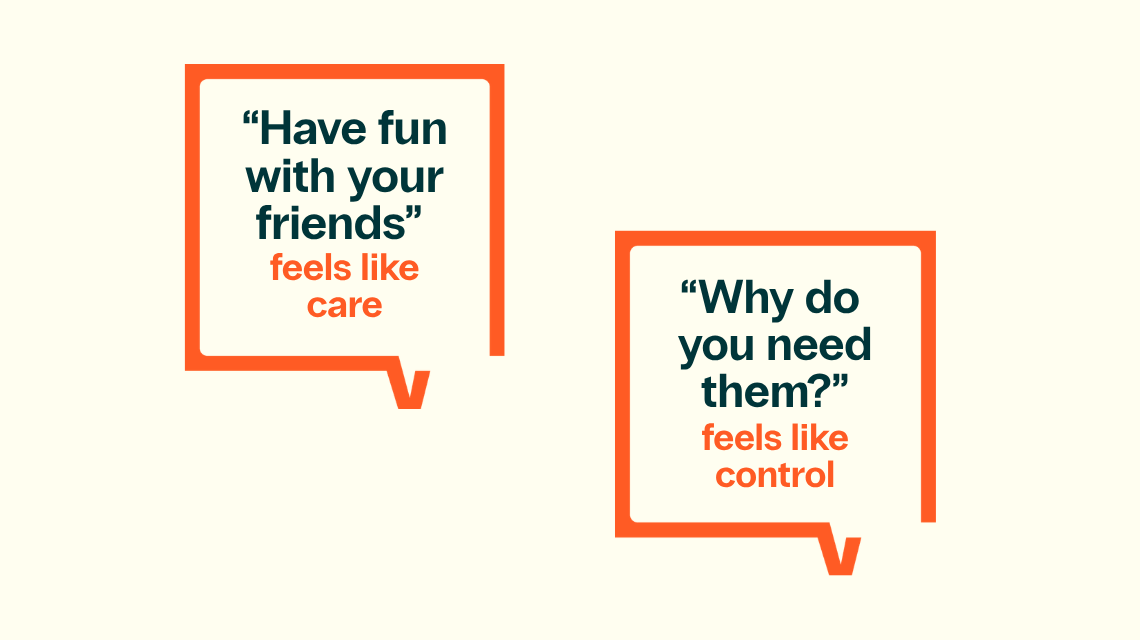
These controlling behaviours are relationship ‘red flags’
They're the little things that build up and leave you feeling confused or unsure... Like you’re walking on eggshells, or maybe like you’re being ‘irrational’.
When we know how to see the signs of controlling behaviour (and what they can lead to), we can help each other recognise the difference between care and coercive control. It might be happening to you, or you might see it happening to someone you know.
The difference between care and control matters: because we all have a right to feel safe with the people we love.

Coercive control is a pattern of ongoing, continuous abuse over time that’s often covert and difficult to identify.
Forms of coercive control can include:
While coercive control may coincide with physical or sexual violence, it can be an extremely harmful feature of a violent relationship long before any physical violence takes place. It is not less serious when it is not physical.
See the Signs campaign resources
Download these resources to share See the Signs in your community, workplace, school, or sports club.
- Posters
- Social media
- Videos
Get support
If you're concerned about something happening in your relationship, or the relationship of someone you know, you don't have to work through those concerns alone. You can reach out to a specialist support service for advice, including:
- Safe Steps: 24/7 family and domestic violence crisis response for all Victorians.Call 1800 015 188 or chat online.
- 1800RESPECT: National domestic, family and sexual violence counselling service. Call 1800 737 732, or get support by text message, online chat or video call.
- InTouch: For migrant and refugee women experiencing family violence. Call 1800 755 988.
Support like the Men's Referral Service is available for men who are concerned about their own behaviours and want to change. It's a free, anonymous, 24/7 counselling service. Call 1300 766 491.
If you're concerned for your safety, or are in an emergency situation, please call 000 for urgent police assistance.
About See the Signs
See the Signs is a statewide public education campaign from Respect Victoria designed to help Victorians better understand and recognise coercive control.
Coercive control can be difficult to identify because it does not always involve physical violence, and individual behaviours can sometimes be mistaken for care, concern or affection. Through relatable, real-life scenarios, the campaign encourages people to think about the difference between behaviours that are part of a healthy, respectful relationship and behaviours that may be controlling or coercive.
At its heart, See the Signs reinforces that respect, equality, choice and independence are fundamental to healthy and safe relationships. By increasing understanding of coercive control and its early warning signs, the campaign aims to support earlier recognition, informed conversations and help-seeking before harm escalates.
Coercive control is a pattern of behaviours that can be used to control another person and progressively take away their autonomy, independence and freedom.
It can include emotional abuse, financial control, isolation from friends or family, surveillance or monitoring, intimidation and manipulation. These behaviours may occur together and can develop or intensify over time.
Healthy relationships are based on respect, equality, choice and independence.
While every relationship is different, people in healthy relationships should be able to maintain their own identity and independence, make choices and have those choices respected.
See the Signs encourages people to consider whether behaviours within a relationship support these foundations or whether they are instead being used to restrict someone’s autonomy, choices or independence.
Building greater community understanding of what healthy, respectful relationships look like is an important part of helping people recognise when behaviours cross the line from care into control.
Coercive control is a form of intimate partner violence that shows up as a pattern of behaviour in relationships. Community understanding of it remains limited. Unlike physical violence, coercive control can involve subtle and cumulative behaviours that are difficult to recognise and may be normalised or misunderstood.
Victim survivors have consistently identified this lack of public understanding as an important gap in Victoria’s approach to preventing family violence and gendered violence more broadly.
Since the Victorian Victim Survivors’ Advisory Council (VSAC) was established in 2016, members have advocated for greater awareness of the often-hidden patterns of abuse that can precede and accompany family violence. Their lived experience has highlighted how coercive control can go unrecognised until abuse has significantly escalated, delaying opportunities for earlier recognition, support and prevention.
See the Signs has therefore been developed in direct response to long-standing victim survivor advocacy, as part of broader efforts to prevent family violence before it occurs.
Coercive control can develop and escalate over time, and it can occur long before physical violence. Because some controlling behaviours can initially appear subtle or be mistaken for care or concern, people may not immediately recognise what they are experiencing or observing as harmful.
Helping people recognise these behaviours earlier can create opportunities to seek information, have supportive conversations and access help before harm escalates.
Increasing community understanding of coercive control is therefore an important part of preventing gendered violence and supporting earlier recognition and action.
The Victorian Government has announced its intention to criminalise coercive control, and the Department of Justice and Community Safety is progressing legislative reform.
See the Signs, however, is not a campaign about criminal offences or legal penalties. It is a primary prevention and public education campaign designed to increase community understanding of coercive control and help Victorians recognise controlling and coercive behaviours earlier.
The campaign complements broader reforms related to coercive control by building community understanding of coercive control and supporting prevention before legal intervention may become necessary.
Legislation is an important part of responding to coercive control, but legislation alone cannot prevent it from occurring.
Criminal justice responses are necessarily reactive. They generally intervene after harmful behaviour has occurred. Primary prevention works further upstream by increasing community understanding and addressing the attitudes, behaviours and social norms that contribute to gendered violence.
By improving community understanding of coercive control and why these behaviours are harmful, the campaign aims to support earlier recognition and prevention before legal intervention becomes necessary.
The campaign creative depicts the most common pattern of coercive control in intimate partner violence, in which women are victim survivors and men are perpetrators. This reflects the evidence base underpinning the campaign and the gendered patterns of family violence.
At the same time, Respect Victoria recognises that men and people of all genders can experience family violence. Supporting campaign information and communications will acknowledge the diversity of people’s experiences while reflecting the evidence about the predominant pattern of coercive control in intimate partner violence.
No. See the Signs is a public education campaign designed to build understanding across Victorian communities.
While the campaign may help someone recognise behaviours they are experiencing in their own relationship, including their own behaviours, it is also intended to help friends, family members and the broader community better understand coercive control.
Building community understanding can make it easier to recognise concerning patterns of behaviour, have informed and supportive conversations, and know where to look for further information.
See the Signs is a statewide campaign for Victorians, with paid advertising primarily targeting men and women aged 18–39.
The campaign creative has a particular focus on people who may be beginning to enter their first serious relationships. This provides an opportunity to build understanding of healthy, respectful relationships and the warning signs of controlling behaviour at a point when people may be establishing expectations and patterns within their relationships. This reflects the campaign’s primary prevention approach: rather than waiting until harmful patterns have become established or escalated, See the Signs seeks to build knowledge and understanding earlier.
Advertising will reach audiences across metropolitan and regional Victoria. Men have also been identified as an important audience, with tailored approaches planned across channels including audio, sport and social media.
See the Signs will be delivered across Victoria using a mix of advertising channels designed to reach audiences in the places where they get their news and information.
The campaign takes a digital-first approach, including social media platforms such as TikTok, Instagram and Reddit, as well as search, audio and out-of-home advertising. Campaign materials also include video, radio, static social media and out-of-home creative.
The media approach is designed to reach people across metropolitan and regional Victoria, using channels that reflect the media habits of the campaign’s audience.
Yes. See the Signs was originally developed by the South Australian Government and has been licensed and adapted by Respect Victoria for Victorian audiences.
The South Australian campaign went through a comprehensive development process that included audience research, concept testing, stakeholder consultation and lived experience input. Following its launch, it demonstrated strong reach and engagement and received sector support.
The Victorian Victim Survivors’ Advisory Council identified See the Signs as its preferred campaign model for Victoria, recognising its ability to communicate the often-hidden patterns of coercive control in a way that is authentic, relatable and grounded in lived experience.
Developing a new statewide campaign is a significant process and can take around two years, including audience research, stakeholder consultation, concept testing, creative development, production and evaluation.
Rather than duplicate significant research and creative development already undertaken by another Australian jurisdiction, Respect Victoria has licensed an established, evidence-informed campaign and adapted it for Victoria.
This enables public education to begin sooner while representing a responsible and cost-effective use of public funds. Victorian investment can instead be directed towards local implementation, stakeholder engagement, communications, media planning, digital content, moderation, evaluation and supporting resources.
The campaign is also being tailored to Victoria’s policy, legislative and service context through Victorian stakeholder engagement and ongoing consultation with victim survivors and the family violence sector.
Yes. Victim survivor advocacy has been central to the decision to deliver a Victorian public education campaign about coercive control.
Members of the Victorian Victim Survivors’ Advisory Council have consistently advocated for greater community understanding of the often-hidden patterns of abuse that underpin family violence. VSAC also identified See the Signs as its preferred campaign model for Victoria.
Respect Victoria will continue engaging with VSAC throughout campaign delivery, alongside the Aboriginal community-controlled sector, specialist family violence services, legal services and prevention sector partners. This ongoing engagement is intended to ensure implementation continues to be informed by lived experience, contemporary evidence and sector expertise.
While the core campaign was originally developed in South Australia, Respect Victoria is adapting it for Victoria’s policy, legislative, prevention and service context.
This includes Victorian stakeholder engagement, adaptation of supporting communications and web content, local media planning and ongoing consultation with victim survivors and the family violence sector.
This approach allows Victoria to benefit from an established, evidence-informed and tested campaign while ensuring the information, communications and pathways surrounding it are appropriate for Victorian audiences.
Respect Victoria will evaluate the campaign to understand both how effectively it reaches Victorians and whether it is helping to improve understanding of coercive control.
Measures may include campaign reach and engagement, audience recall and recognition of campaign messages, visits to the campaign website and information-seeking behaviour, community sentiment and qualitative feedback.
If something you see or hear in See the Signs feels familiar or raises concerns, the campaign encourages you to find out more about coercive control and the signs to look out for.
The links on this page provide further information about the campaign’s key messages and pathways to additional resources and support services. These external resources include practical tools, research and information for people wanting to better understand healthy, respectful relationships or support friends and family.
The purpose of the campaign is to encourage earlier recognition, informed conversations and help-seeking where appropriate.