

On this page
This section aligns with the following domain of the Theory of Change:
- 1.4 Theoretical and practice frameworks
- 1.5 Quality programs
The field of gendered violence prevention has evolved over many decades, emerging from and building on health promotion and prevention science theory, evidence and practice. National primary prevention frameworks such as Change the story, Changing the picture, Changing the landscape and Pride in Prevention have provided a strong theoretical basis for prevention work over the past decade.
Where progress has been made
The evidence-base for prevention is continuously evolving to inform a deeper understanding of what works to prevent the many forms of family and gendered violence, and the development of effective practices and approaches. This was particularly evident over this reporting period, with the national Rapid Review of Prevention Approaches catalysing discussion on the expansive nature of prevention work.
Updating and expanding prevention frameworks and tools
The Dhelk Dja Koori Caucus worked with the Victorian Government to review the Indigenous Family Violence Primary Prevention Framework, which was first developed in 2012. The framework reflects Aboriginal ways of knowing, being and doing, and places Aboriginal leadership at the centre of long-term, systemic change. A refreshed framework is due for release in 2025. It will underpin prevention work with Aboriginal communities, and ACCOs must be supported to lead this work (130).
Our Watch and Rainbow Health Australia are currently developing a national framework to prevent violence against LGBTIQA+ people and communities, which will build on existing guidance in Pride and Prevention to make an important contribution to strengthening intersectional prevention practice, including through articulating the drivers of violence against LGBTIQA+ people and their overlap with the drivers of violence against women.
Our Watch also partnered with Women with Disabilities Victoria to develop new tools, released in July 2024, for primary prevention services and frontline staff working with people with disabilities. These tools and resources will support practitioners to operationalise the Changing the landscape framework and progress practice approaches to preventing violence against women with disabilities.
The National Plan to End Violence against Women and Children 2022–2032 recognised that women and children have different needs at different points of their lives. Building upon this, Celebrate Ageing developed The [un]Silencing of Older Women (2024) to link the experiences and needs of older women to key components of the National Plan, applying a life stages approach to addressing elder abuse (215).
Bespoke, place-based approaches
Report participants stressed the importance of communities being involved in the design and delivery of programs and activities, and therefore the need to fund and support community-led organisations to lead prevention work. They also spoke about the importance of place and context in prevention work, noting that readiness levels, needs and social norms vary widely across the state.
There is a growing recognition that there is need for more bespoke approaches for different cohorts of people, and different parts of the country too. – Anonymous report participant
The Systems Mapping project brought Respect Victoria, women’s health services and other partners together to explore the importance of local context in prevention delivery. The project used group model building to map the barriers to and enablers of local violence against women and gendered violence prevention efforts. While some influences were common across geographical boundaries, such as collaboration, workforce development, power sharing and leadership diversity, many were unique to place. This work demonstrates both the value of practice-led inquiry to grow prevention knowledge and the importance of understanding place in successful program delivery.
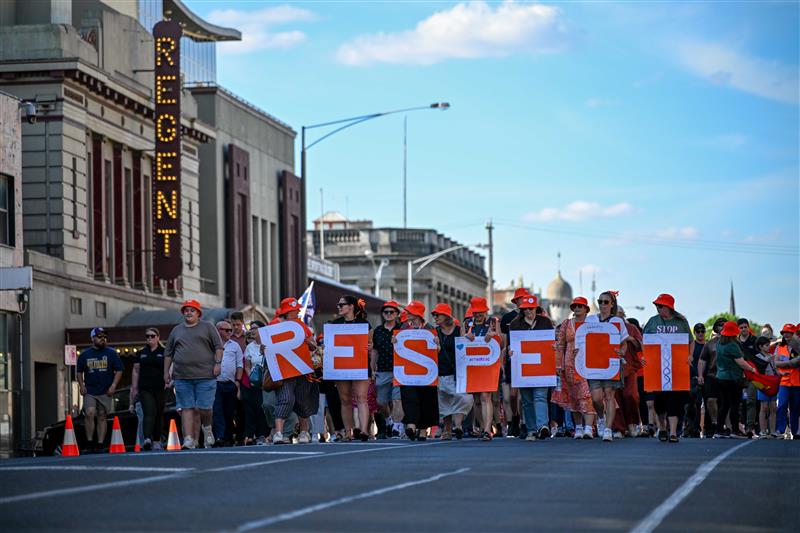
While place-based prevention has long been championed by women’s health services, it had not been funded at scale until the announcement of Respect Ballarat in May 2024. Prior to this, Respect Victoria commissioned a review of Australian and international literature to understand how a ‘saturation model’ adds to the understanding of what works to prevent violence against women. This review will underpin the development of Respect Ballarat (see case study below).
I really like the Ballarat saturation model ... it makes it real for people that don’t necessarily understand how advocacy, communications campaigns and research all link together. There is a great opportunity for Respect Victoria to consider rolling this model out in other areas based on the data, risk factors and what we know about the implementation of the Ballarat model. – Sally Hasler, Women’s Health Victoria
Several report participants noted that this project will provide an opportunity to develop and test effective approaches to designing and resourcing complex place-based prevention of gendered violence. While international evidence suggests that multi-strategy, mutually reinforcing approaches are promising in terms of creating impact, this project will grow understanding of its applicability to the Victorian context.
Where there are challenges
Integrating prevention frameworks
Report participants widely acknowledged that addressing gendered drivers of family violence and violence against women remains critical, and they also highlighted the need to better integrate overlapping and intersecting drivers of violence arising from other forms of structural oppression into prevention approaches (those outlined in Changing the picture, Changing the landscape and Pride in Prevention).
One of the issues that we face is that often disability is still an add-on, and there can also be a resistance in the community, even amongst people that would call themselves feminists, of seeing [adding a disability lens] as a dilution of what needs to happen, rather than something that is elevating and bringing [prevention] up. – Julie Kun, Women with Disabilities Victoria
We all have a responsibility to address the additional drivers of violence against LGBTIQA+ people, including homophobia, biphobia, transphobia and transmisogyny – they should be key targets in achieving gender equity. – Starlady, Zoe Belle Gender Collective

Tailored and targeted approaches
Report participants acknowledged that while universal primary prevention approaches that target the whole population remain crucial, there is a need to develop and implement more tailored and targeted prevention programs and approaches. This includes the need for more culturally and age-appropriate approaches across the life course, as well as approaches tailored to specific contexts and settings.
There’s no one-size-fits-all approach to doing this work. We need to tailor our approaches so that they make sense to – and meet the needs of – the communities with whom we are working. For example, we need to support communities with different languages and cultural backgrounds to understand the issues and how they can have these conversations with their children. Factors such as age, gender, sexuality, disability, neurodivergence, geography and experiences of violence also need to be considered. Being informed by the communities we’re working with is critical. – Marree Crabbe, It’s Time We Talked
Report participants highlighted the need to continue to strengthen a focus on causes of violence outside the gendered drivers (including ‘reinforcing factors’) and integrate them into prevention practice and approaches. They noted that prevention policy and practice has largely focused on men’s physical intimate partner violence against women and that – while it is essential to keep driving that work forward – there is also a need to develop and use evidence and practice frameworks on other types of violence, particularly in relation to sexual violence, elder abuse, child maltreatment and non-physical forms of violence (e.g. financial/economic abuse, coercive control).
Work has commenced to develop a Victorian primary prevention of elder abuse framework by the Department of Families, Fairness and Housing.
One of the biggest issues is that the drivers of elder abuse are not as well understood. It’s very hard to get that message out. – Ben Rogers, Council on the Ageing Victoria & Senior Rights Victoria
Several report participants also spoke about the need to develop and test prevention interventions on specific forms of violence, namely sexual violence, online and technology-facilitated abuse, as well as interventions that prevent and address the harms of pornography. As noted earlier, while a sexual violence strategy was announced by the Victorian Government in 2022, it has yet to be released.
We need a sexual violence strategy that really sets out a framework for evidence-based sexual violence prevention. Really, that’s a foundational building block. – Kathleen Maltzahn, Sexual Assault Services Victoria
Early intervention
Early intervention was noted as a particular gap requiring a greater policy focus, as well as more programs targeting people and groups at higher risk of using violence, or showing early signs of harmful beliefs and behaviours. This was also a strong theme of consultations, with report participants highlighting work with children and young people and ‘at-risk’ men and boys as particularly important priorities for this work.
Across Australia, there’s a need for a much greater focus on early intervention as a core component of how we address family violence across the spectrum. It needs a lot more attention. – Jo Pride, Family Safety Victoria
There’s a need for similar kind of foundational policy settings as it relates to early intervention work – Matt Tyler, Jesuit Social Services
Primary prevention and early intervention are distinct but complementary and linked approaches. There is an opportunity for more integrated approaches that combine primary prevention and early intervention, and more practice evidence and guidance is needed for these integrated approaches. There are already promising developments driven by organisations such as Jesuit Social Services, Body Safety Australia, Djirra, the Multicultural Centre for Women’s Health and local council programs such as new parent groups and youth services. However, greater integration and coordination of early intervention alongside prevention is needed to guide future investment and practice.
Increased visibility and coordination of distinct and integrated approaches would also enhance Victoria’s ability to demonstrate the collective, preventative impacts of work across primary prevention, early intervention and response, and it would illustrate the true spectrum of action and investment required to end family violence and violence against women.
A lot of critique of the primary prevention sector has been about its [perceived] lack of integration with the comprehensive gender-based violence sector … But I think that there’s enough prevention literacy amongst people that understand early intervention and response and recovery that we’re not going to lose the integrity of prevention by being more integrated – Prevention organisation executive
A challenge for prevention is the intersection between primary prevention [and] secondary prevention: early intervention for people facing higher risk. I think that’s a gap between primary prevention and response, and that space in between is still a really problematic one. – Jade Blakkarly, WIRE
Opportunities for action
Place-based approaches can accelerate progress
Place-based approaches can build lasting, community-driven change. Respect Ballarat is the first initiative of its kind in Australia and has the potential to improve Victoria and Australia’s understanding of what works to prevent gendered violence on a wider scale – accelerating progress and maximising impact of the sector’s collective efforts. It is based on global evidence that demonstrates that ‘saturating’ an area with multiple activities that mutually reinforce each other has significantly more impact than relying on a single method or setting.
Continued investment across Victoria – building on initiatives such as Respect Ballarat as well as regional coordination of women’s health services, local government, ACCOs and others – can drive locally tailored prevention, community readiness, and partnership expertise. Advocating for matched investment from the Australian Government will support scale and sustainability, ensuring that promising practice can be embedded and expanded across regions.
Addressing commercial determinants and market-based contributors
While prevention frameworks and practitioners have long acknowledged the various systems and structures that drive and enable violence, report participants reflected that increased national discourse on the role of commercial and market-based contributors to family violence and violence against women during the reporting period had brought renewed opportunity for cross-sector and cross-government collaboration.
The prevention sector has never been funded at the scale required to address, for example, the impact of gambling, alcohol, violent pornography or digital platforms that profit from online algorithms that spread gendered disinformation and misogyny. Yet, these global, multibillion-dollar industries have untrammelled power to undermine prevention efforts and entrench the harmful social norms, attitudes and systems that drive family violence, gendered violence and violence against women.
Therefore, prevention organisations must partner with adjacent sectors that are funded to do this work, such as health promotion organisations and others. Addressing the commercial determinants of violence is essential for long-term prevention of not just gendered violence but also a myriad of other social harms. Industries and environments that profit from or perpetuate gendered harms – such as alcohol, gambling, violent pornography, and online platforms and business models that support misogynistic radicalisation – must be subject to greater scrutiny and coordinated regulation. Discrete community-facing prevention programs cannot be expected to generate whole-of-population change unless strategic, evidence-based and courageous action is taken to curb the influence of these industries on driving and reinforcing harmful social norms, attitudes and behaviours.
The Victorian Government should support collaboration across sectors, portfolios and jurisdictions, including through public policy, regulatory reform, and partnerships with allied sectors and settings that have significant cultural influence such as community and professional sport.
In addition, there is increasing evidence and recognition of a pathway from online misogyny to radical extremism, often fuelled by gendered disinformation campaigns that stoke misogynist, anti-trans and/or racist prejudice (216). Gendered disinformation, as explained in Disinformation in the City, is the use of humiliating and sexualised content to spread misogynistic messaging in the community that is overwhelmingly about women and girls (217).
The negative consequences [of gendered disinformation] go far beyond the targeted individuals and undermine human rights, gender equality, inclusive democracy and sustainable development – UN Special Rapporteur Irene Khan (218)
This is creating a new intersection between the priorities, expertise and mandate of those undertaking gendered violence prevention work and those responsible for deradicalisation and national security. In addition, evidence is building about the widespread harms of gendered disinformation by local and international actors (both online and offline) that undermines prevention efforts and reinforces drivers of violence (217). Experts have highlighted the urgency of collaborative, preventative action required by governments at all levels, sectors and community groups to pre-empt, ‘pre-bunk’ and de-bunk such efforts (217). Harnessing public sentiment and renewed momentum will be crucial for supporting cross-sector and inter-jurisdictional collaboration to address these issues going forward.
Integration and collaboration
There is increasing recognition that primary prevention can be – and often is – integrated across the prevention-to-recovery continuum, to address both immediate needs and the underlying drivers of violence. As outlined throughout this report, ongoing work to ensure an enabling policy and funding environment and a mature and sustainably resourced prevention system will foster more integrated practice and partnerships within and across allied sectors and settings in order to better connect and integrate prevention work for maximum impact.
Recommendations
Respect Victoria recommends that the Victorian Government:
- Continue to invest in and build ‘saturation’ and place-based prevention and early intervention initiatives to prevent family and gendered violence across Victoria, including through:
- building on lessons from Respect Ballarat (the Ballarat Community Saturation Model) to guide longer-term (up to 10 years) investment in Ballarat and other sites across Victoria to enable impacts on gendered violence rates to be demonstrated
- advocating to other jurisdictions to learn from the development and implementation of the Respect Ballarat project and to build the workforce and system readiness required to pilot similar initiatives across Australian states and territories.
- Work with prevention-focused organisations and agencies to better connect and integrate prevention work through:
- expanding efforts to design and deliver integrated prevention approaches, particularly those that combine primary prevention and early intervention approaches
- collaborating with other sectors to develop and deliver nuanced and effective prevention messaging, including through amplifying community voices and diversifying the prevention workforce
- identifying strategic opportunities to embed prevention lessons across early intervention, crisis response and recovery efforts, particularly in the justice system, housing, health and other social service systems.
- Work with and advocate to the Australian Government and other Australian state and territory governments and agencies to address the commercial and systemic contributors to family violence, violence against women and gendered violence, including by regulating and/or supporting increased cross-sector collaboration on:
- alcohol pricing, availability and advertising
- gambling access and advertising
- production, dissemination and access to violent pornography, particularly for children and young people
- misogynistic radicalisation and gendered disinformation
- interlinking social norms around masculinity, sport, drinking, gambling and pornography that normalise and drive family violence, violence against women and gendered violence.