

On this page
Snapshot of positive progress and change: 2022–24
Greater community interest, awareness and demands for change
- Report participants highlighted increased community interest in, conversations about, and willingness to take action on prevention, with 69% of survey recipients feeling awareness of the Victorian community about gendered violence is better than it was three years ago.
- The annual Walk Against Family Violence drew increasing numbers each year, with an estimated 8,500 Victorians joining the walk in 2024 (up from 5,000 in 2023).
- Respect Victoria engaged an average of 1.65 million Victorians through social change campaigns.
- The National Community Attitudes towards Violence against Women Survey (NCAS) results released in 2023 show over two-thirds (68%) of Victorians reject violence-supportive attitudes.
- Community-based prevention activities were initiated in every local council area across the state through the 16 Days of Activism against Gender-based Violence Campaign in 2023 and 2024, with 90% of grassroots funding recipients agreeing that the initiative contributed to increased awareness and knowledge of the issues and/or transforming harmful attitudes.
Continued political leadership and investment
- All 227 Royal Commission into Family Violence recommendations were acquitted.
- Victoria appointed Australia’s first Parliamentary Secretary for Men’s Behaviour Change (2024) and created a dedicated ministerial portfolio for children (2023).
- The Victorian Government invested an estimated $130 million in prevention across state budgets over the reporting period – more than any other state or territory (footnote 1).
- The Victorian Government invested $9.8 million in 2024 for Respect Victoria to design and deliver the world-leading ‘Respect Ballarat: A community model to prevent gendered violence' (footnote 2).
- The Victorian Government invested a further $46.9 million in the Respectful Relationships initiative.
Significant policy and legislative developments
- Victoria’s second Free from Violence action plan was released in 2022, with all actions delivered or on track to be delivered at the time of writing.
- Strong foundations: Building on Victoria’s work to end family violence, released in 2023, set the direction for the next phase of family violence reform.
- Our equal state: Victoria’s gender equality strategy and action plan 2023-2027 was launched in 2023.
- The Victorian Government actioned the Fair Access Policy Roadmap to ensure fairer access to community sports facilities for women and girls (2022).
- The Victorian Parliament made affirmative sexual consent the law and created offences for non-fatal strangulation in 2022.
- WorkSafe Victoria and the Victorian Equal Opportunity and Human Rights Commission partnered in 2023 to strengthen Victoria’s regulatory approach to preventing and addressing work-related sexual harassment.
Maturing of prevention system infrastructure
- Respect Victoria developed a Statewide Theory of Change, enabling a shared understanding of collective progress in Victoria.
- Report participants highlighted more and stronger collaboration across prevention efforts (footnote 3).
- Respect Victoria’s leadership and system coordination role strengthened, including through Respect Victoria establishing and growing the Prevention Alliance from 2022 onwards.
- Local government engagement in gender equality and prevention continued to grow and strengthen through centralised support and infrastructure under the Municipal Association of Victoria.
- Regional violence prevention partnerships, led by women’s health services, continued to enable place-based coordination and impact across the state.
Ongoing workforce growth and development
- Over 4,000 people participated in the Partners in Prevention Network (convened by Safe and Equal), which grew by more than 800 people in this period.
- Framing the Future, the second rolling action plan under Victoria’s Building from Strength 10-Year Industry Plan for Family Violence Prevention and Response, was released in 2024 (91).
- Safe and Equal’s Foundations for Action report, released in 2024, mapped the prevention workforce and outlined priorities for action.
- Work commenced to deliver a dedicated Prevention Capability Framework.
New research and evidence
- NCAS results were published by ANROWS and a Victorian boosted sample analysed by Respect Victoria to better understand state-level change (2021) (92).
- The Aboriginal Family Violence Prevention Mapping Project (2022) and the Aboriginal Family Violence Prevention Evidence Review (2023) were released (19, 93).
- The 2024 National Man Box study report was released by Jesuit Social Services in partnership with Respect Victoria, together with Respect Victoria's companion report, Willing, capable and confident: Engaging men in the prevention of violence against women (94, 95)
- The evidence base continues to build with key literature reviews published by Respect Victoria including a synthesis of global and Australian evidence on prevention interventions to support Respect Ballarat and a suite of papers through the Summarising the Evidence project (23, 96-102).
Promising community-led work and self-determined prevention
- The Yoorrook Justice Commission delivered its Yoorrook for Transformation recommendations, including three with a focus on family violence prevention (2024).
- Victoria’s Indigenous Family Violence Primary Prevention Framework (2022) was refreshed, along with the ongoing leadership and program delivery by ACCOs (e.g. Djirra’s Koori Women’s Place delivered 435 workshops to almost 2,200 participants).
- Culturally tailored community initiatives delivered by 33 organisations under the Supporting Multicultural and Faith Communities to Prevent Family Violence Program reached over 35,000 people and 80 multicultural and faith communities across Victoria.
- Rainbow Health Australia and Zoe Belle Gender Collective upskilled prevention organisations in addressing queerphobia and transmisogyny through their work.
- Changing the landscape practice resources were developed in partnership between Our Watch and Women with Disabilities Victoria.
Evolving prevention practice and approaches
- Integration and expansion continued for prevention frameworks and practice guidance, for example, the Safe and Inclusive Sport: Preventing Gender-based Violence Guide.
- Place-based approaches gained support, including through the announcement of Respect Ballarat on 31 May 2024.
- Increased focus, strategies and partnerships sought to engage men and boys as active contributors and allies in prevention, including through the work of Jesuit Social Services and the development of Respect Victoria’s What Kind of Man Do You Want to Be? campaign.
- Support and opportunity increased for collaboration across primary prevention, early intervention, response and recovery, as well as between the prevention sector and organisations working on aligned causes such as reducing the harmful use of alcohol and other drugs, problem gambling and online harms (footnote 4).
Progress since the inaugural Three Yearly Report
The first Three Yearly Report to Parliament captured the foundational elements of Victoria’s prevention system that had been built following the state’s Royal Commission into Family Violence. It was delivered in September 2022 and marked the three-year anniversary of Respect Victoria. It acknowledged that Victoria’s prevention efforts, borne out of decades of advocacy, were also due in large part to the state’s sexual assault services and network of women’s health services. The report provided the opportunity to showcase the spread of prevention work across the state and highlight the early coordinated understanding of the level of investment, system infrastructure and workforce capability required to end violence.
Three years on, there have been promising developments and achievements towards this goal, albeit with much more work to do and emerging challenges to address.
With a Statewide Theory of Change now in place, coordinated by Respect Victoria with prevention sector partners, tracking progress in prevention is more transparent, accessible and coordinated. Available data shows that most of Victoria’s progress has been focused on the enabling layers of change, with some progress towards indicators that suggest shifting social norms, behaviours and structures (discussed in more detail in Community awareness, understanding and behaviour change). Progress includes embedding the Gender Equality Act 2020 (Vic) across the Victorian public sector, statewide workforce strengthening activities, and campaigns and initiatives that build community understanding of gendered violence and support leaders to speak out.
This sequencing of progress against the different layers of change outlined in the Statewide Theory of Change broadly reflects the Victorian Government’s phased approach to primary prevention, as outlined in the 10-year Free from Violence strategy (5). As noted earlier, the Free from Violence Second Action Plan (2022–2025) focused on ‘strengthening whole-of-community efforts and actions’ in preparation for an anticipated third phase from 2025–2027 of ‘maintaining efforts and getting results’ which was the anticipated goal for 2025–2028 and will now be consolidated into the government’s implementation of the recently released Until every Victorian is safe: Third rolling action plan to end family and sexual violence 2025 to 2027 (67, 68).
With the benefit of a Statewide Theory of Change, ongoing leadership and commitment to prevention and robust data collection and evaluation, tracking progress in future will be more streamlined and targeted, and provide a clearer picture of prevention progress and outcomes.
Statewide Theory of Change
During the reporting period, Respect Victoria developed a Statewide Theory of Change for the primary prevention of gendered violence, and this outlined the anticipated change pathway by describing short-, medium- and long-term expected outcomes.
Developed with many prevention specialist individuals and organisations, it draws on the input of researchers, practitioners, evaluators and policymakers with the purpose of:
- creating a common language across the primary prevention sector and community of shared outcomes
- showing the logic and sequence of expected outcomes arising out of the prevention system
- tracking pathways to preventing violence
- illustrating where the efforts of diverse stakeholders fit within the bigger picture of prevention work
- monitoring and evaluating outcomes against the evidence to allow for adjustment.
The Statewide Theory of Change contains five layers, with long-term outcomes (or ultimate goals) captured in the top layer. Change is not linear, so each layer should be interpreted as a set of conditions that enable the layer above to occur. Together, these five layers tell a story about the predicted change over time. Measuring collective statewide progress against this Theory of Change allows Victoria to have a shared understanding of collective progress.
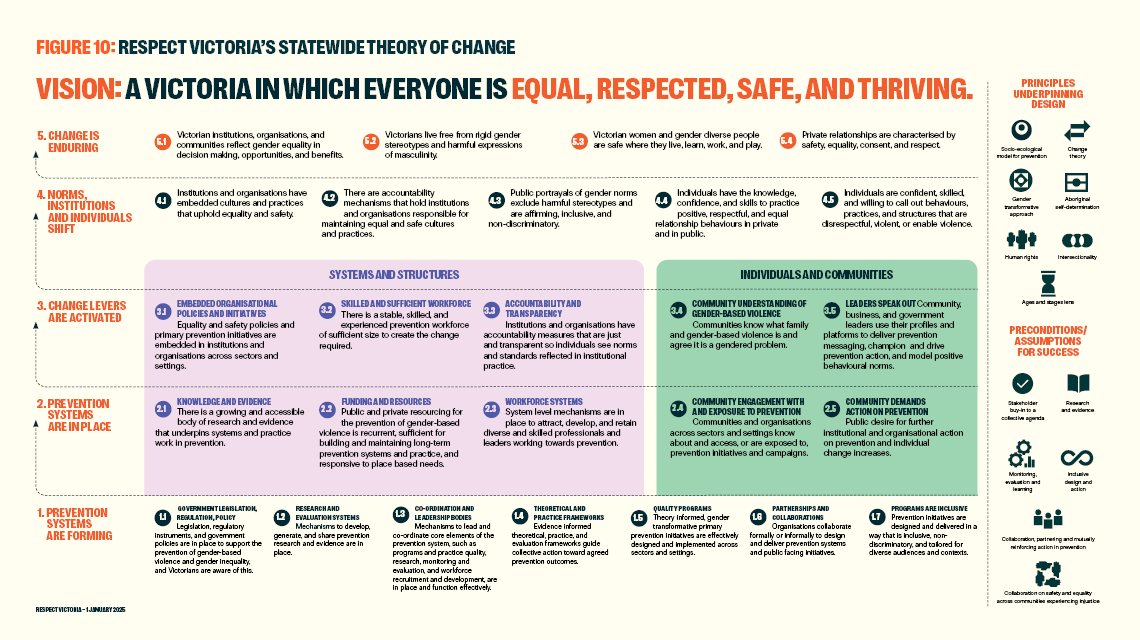
How Victoria’s prevention practitioners view progress
As part of this review, Respect Victoria surveyed people who work in prevention organisations and prevention practitioners about their perceptions of progress over the last three years. We used a snowball sampling technique to ensure the survey reached a wide range of stakeholders involved in prevention work across settings and sectors, and to ensure a broad range of perspectives were captured (footnote 5).
Overall, the results (see below) indicated that practitioners perceive the Victorian community is more aware of gendered violence than it was three years ago and that the quality of Victorian community-led action to prevent gendered violence, the inclusion of trans and gender diverse people, and the extent of media outlets reporting on gendered violence are all better than they were three years ago. These are indications of positive progress.
Other results indicate where we have more work to do. For example, only one-third of practitioners perceive that the political will of Victorian MPs to address gendered violence is better than it was three years ago, and only one-third believe that men’s willingness to discuss their role in preventing gendered violence and to actively participate in initiatives is better than it was three years ago.
Respondents' perceptions of progress made in prevention activities
(N = 50)
In the PDF publication of this report, this list was presented as 'Figure 11'.
- 69% of respondents perceived that awareness of the Victorian community about gendered violence is better than it was three years ago
- 65% of respondents perceived that efforts to ensure that prevention of gendered violence initiatives in Victoria are more inclusive of trans and gender diverse people than three years ago
- 59% of respondents perceived that the extent of media outlets reporting on gendered violence is better than it was three years ago
- 56% of respondents perceived that the quality of Victorian community-led action to prevent gendered violence is better than it was three years ago
- 56% of respondents perceived that the amount of media coverage about gendered violence is better than it was three years ago
- 50% of respondents perceived that Victorian community readiness to take action to prevent gendered violence is better than it was three years ago
- 35% of respondents perceived that the political will of Victorian state MPs to address gendered violence is better than it was three years ago
- 32% of respondents perceived that men's willingness to discuss and learn more about their role in preventing gendered violence is either much better or somewhat better than it was three years ago
- 28% of respondents perceived that men's and boys' active participation in initiatives to prevent gendered violence is either much better or somewhat better than it was three years ago
Footnotes
See Prevention investment for further details.
Formerly the 'Ballarat Community Saturation Model' and hereafter referred to in this report as 'Respect Ballarat'.
Specific examples are outlined in Strengthening the prevention system and Recognising and enabling community-led and specialist prevention work.
This is a finding of this report drawn from informant interviews, consultations and desktop data review. See Evolving prevention practice and approaches for further details.
See Appendix 2 for a copy of the full survey. Survey respondents were invited to skip questions, so the response rate for individual questions varied.