

On this page
This section aligns with the following domain of the Theory of Change:
- 2.2 Funding and resources
Preventing family violence, gendered violence and all forms of violence against women requires sustained, adequate investment and action to address entrenched social norms, attitudes, behaviours and systems that drive and reinforce violence in all the places that Victorians live, work, learn and socialise. The Victorian Government has continued to provide investment for prevention system infrastructure and activity over the last three years, investing more than any other state or territory.
Where progress has been made
Free from violence: Second action plan 2022–2025 outlined the Victorian Government’s key focus for primary prevention investment and leadership over the reporting period – specifically, to scale up work in key settings and strengthen whole-of-community efforts, while continuing to trial, test and build the evidence base for emerging work (67).
The Victorian Government invested an estimated $130 million toward prevention between 2022–23 and 2024–25 (see table below) (footnote 1). Most of the prevention programs were funded under Free from Violence through the Prevention of Family Violence portfolio together with the 2024 Strengthening Women’s Safety Package, with significant additional investment in the Education portfolio for Respectful Relationships and support for Elder Abuse Prevention Networks through the Ageing portfolio. Under the Dhelk Dja Partnership Agreement, the Aboriginal Community Initiatives Fund supported and addressed priorities of the Dhelk Dja Action Groups, including but not limited to community-led prevention efforts.
Longer-term (i.e. three- or four-year) funding agreements were also established with certain programs and organisations leading workforce development and prevention in key settings (footnote 2), alongside investment in emerging priorities such as affirmative consent and prevention and early intervention with men and boys.
Victorian Government–funded primary prevention programs and initiatives 2022-2024
| Programs and organisations | Responsible area of government | Activity | Funding |
|---|---|---|---|
| All Come Out to Play! | Family Safety Victoria | Engages children, parents and early years educators in fun and interactive workshops that explore concepts of gender equality and challenge gender stereotypes. | Playgroup Victoria funded $360,000 over 2023–25 for prevention work in early childhood settings, building on previous funding to Drummond Street Services over 2018–22. |
| Baby Makes 3 program | Family Safety Victoria | Challenges gendered drivers and supports equitable relationships with first-time parents. The program engages parents through perinatal health services and is tailored to meet community need. | healthAbility funded $1.2 million over 2023–26, building on previous 2020–22 funding. |
| Victorian Aboriginal Community Initiatives Fund | Family Safety Victoria | The annual Community Initiatives Fund supports Aboriginal community organisations and community groups to implement community-led projects that educate, prevent, reduce and respond to family violence in Aboriginal communities across Victoria. | The Aboriginal Community Initiatives Fund had a cumulative investment of $5.5 million over the reporting period but this investment is not limited to primary prevention. |
| Early intervention with at-risk young men and boys | Family Safety Victoria | An early intervention initiative that focuses on at-risk young men aged 12–25; delivered by Jesuit Social Services. | Funded $4.2 million through the National Partnership Agreement on Family, Domestic and Sexual Violence Responses to deliver the Change Makers program until 2026. |
| Elder Abuse Prevention Networks | Department of Families, Fairness and Housing | Eight elder abuse prevention networks deliver local action to raise awareness of elder abuse and prevent it from happening, using a primary prevention approach. | The 2023–24 State Budget provided $6 million over four years to continue initiatives to address elder abuse, including the delivery of Elder Abuse Prevention Networks. |
| Free from Violence Local Government Program | Family Safety Victoria & Local Government Victoria | Supports 27 councils to embed gender equality and family violence prevention practices into their work. | Funded with $3.5 million to 15 councils from 2022–25 and $3 million to 12 councils from 2024–27. |
| LGBTIQ Family Violence Prevention Project | Family Safety Victoria | Based on evidence developed by Rainbow Health Australia and published in the 2020 Pride in Prevention guide. | Rainbow Health Australia received $750,000 over 2022–24, building on previous funding over 2019–21 (footnote 3). |
| Municipal Association of Victoria | Family Safety Victoria | Supports the councils funded through the Free from Violence Local Government Program and more broadly all 79 Victorian councils to implement the Local government guide for preventing family violence and all forms of violence against women and deliver effective primary prevention activities and initiatives. | The Municipal Association of Victoria received $950,764 from 2023–26. |
| Gender and Disability Workforce Development Program | Family Safety Victoria | The program equips workers in the prevention and disability sectors with tailored prevention knowledge and skills. | Women with Disabilities Victoria received $1.8 million over 2024–27 to deliver the Gender and Disability Workforce Development Program. |
| Our Watch | Family Safety Victoria | Founded in 2015 to guide prevention efforts under the National Plan to End Violence against Women and Children. | Victoria was a founding member of Our Watch and continued to contribute towards its base funding along with other states and territories. |
Preventing Violence Through Sport Grants Program | Family Safety Victoria & Sport and Recreation Victoria | Supports partnerships between community sport and recreation and prevention organisations, to prevent violence through sport. | Funded $2.3 million for 12 projects from 2022–24 and an additional $1.2 million in 2024–25 for a further year of programming. |
| Prevention in Teaching and Learning project | Family Safety Victoria | Supports partnership between Our Watch and Victorian universities to embed prevention of family violence content in relevant degrees, including public health and early childhood education courses. | Funded $400,000 over 2023–25 to embed prevention content in university courses. |
| Respect Victoria | Family Safety Victoria | Respect Victoria is the dedicated, statutory agency for prevention in Victoria. (See page 28 for details on role, remit and key milestones.) | $3.1 million per year to deliver core legislative functions, and additional lapsing funding of $19.2 million over three years provided in 2022-23 to deliver statewide behaviour change campaigns and evidence based primary prevention activities, supporting the delivery of Free From Violence. |
| Respect Ballarat | Department of Families, Fairness and Housing | The Respect Ballarat model is a new approach that uses place-based, community-led approaches to prevent gendered violence. | Funded $9.8 million through the Strengthening Women’s Safety Package. |
| Statewide Prevention Workforce Development Program | Family Safety Victoria & Department of Education | Supports Safe and Equal to build capability and connection of primary prevention practitioners across Victoria. | Safe and Equal is being funded $4 million to deliver the Statewide Prevention Workforce Development Program. This includes $2.8 million funding through the Department of Families, Fairness and Housing from 2022–26 to deliver sector development, specialised training, the Partners in Prevention network for practitioners, and a biannual conference. The Department of Education is providing $1.2 million over the period 2021–25 to support workforce development relating to respectful relationships education. |
| Supporting Multicultural and Faith Communities to Prevent Family Violence Grant Program | Family Safety Victoria | Grants program for organisations to build the capacity of multicultural and faith communities to prevent family violence and all forms of violence against women. | Funded $9.7 million via a grants program for 33 organisations over 2021–24, with a further year of funding allocated in 2024–25. |
| Supporting Young People to Understand Affirmative Consent Program | Family Safety Victoria | A community-based education program that engages with young people aged 12–25, and their key influencers, across diverse communities, to build their understanding of affirmative consent and sexual violence. | Funded $3.5 million for 12 projects over 2022–24, with a further year of funding allocated for 2024–25. This also includes funding to Sexual Assault Services Victoria, Safe and Equal, and the Youth Affairs Council of Victoria, to provide capacity building and support to funded organisations. |
Women’s Health Services Workforce Capacity Building Program | Family Safety Victoria & Department of Health | Supports 12 women’s health services to build the knowledge and skills of people working in local councils, sports clubs and health services, and a range of other local organisations, to prevent family violence in their communities. The program also supports women’s health services to deliver innovative prevention activities in their communities. |
The 2022–23 State Budget also provided $19.3 million and the 2024–25 State Budget provided $18.3 million to women’s health services. Part of this funding was administered through the Capacity Building Program to support gendered violence prevention activities. |
| Respect and Equality in TAFE Program | Family Safety Victoria & Department of Jobs, Skills, Industry and Regions | Funding provided to Melbourne Polytechnic to lead the implementation of the Respect and Equality in TAFE (RET) Framework across 16 Victorian TAFE and dual-sector universities. The RET Framework outlines a whole-of-TAFE approach to promoting a culture of equality and respect and to address the drivers of gendered violence. | Funded $450,000 over two years (2022–24). |
| Starts With Us | Family Safety Victoria | Women’s Legal Service Victoria’s Starts With Us supported Victorian legal and justice professionals and organisations to implement actions to prevent gendered violence within their workplaces. | Funded $400,000 over three years (2020–23). |

Strengthening Women’s Safety Package
The Victorian Government announced the Strengthening Women’s Safety Package in May 2024 – a suite of reforms to strengthen Victoria’s prevention efforts, provide better support to people experiencing violence when violence occurs, and deliver a stronger justice response to hold perpetrators to account (103). The Strengthening Women’s Safety Package was a response to a series of tragic deaths of women allegedly killed by men across Victoria, including the deaths of two women and the disappearance of another in Ballarat. The package included $9.8 million over four years for Respect Victoria to deliver the place-based ‘Respect Ballarat: A community model to prevent gendered violence’ and $7.8 million over four years for the Respectful Relationships initiative. The package also included an announcement that Respect Victoria would develop a campaign to engage men – particularly young men – in prevention, and this was funded through Respect Victoria’s existing budget.
Dhelk Dja investment
The Victorian Aboriginal Community Initiatives Fund has been in operation for over 20 years and is managed through Family Safety Victoria. It is led by the 11 Dhelk Dja Action Groups and provides annual one-off funding to Aboriginal community organisations and groups to implement community-led projects that educate, prevent, reduce and respond to family violence in Aboriginal communities across Victoria. It has funded more than 400 projects in the past 10 years. Aboriginal-led organisations have consistently called for more sustainable investment through longer-term funding for prevention initiatives, rather than annual grants rounds. This would embed sustainable approaches to preventing and ending family violence in Aboriginal communities.
The 2021–22 round of the Community Initiatives Fund funded 25 culturally appropriate, place-based community-led projects delivered by Aboriginal organisations and community groups across Victoria. Funding was increased by $1 million for the 2022–23 and 2023–24 funding rounds (to a total pool of $2.2 million) to address a lack of prevention funding at the local level.
The 2022–23 Community Initiatives Fund round delivered 42 community-led projects dedicated to preventing and responding to family violence in Victorian Aboriginal communities, and the 2023–24 funding round delivered 44 projects. Successful projects included:
- a prevention program that engages young people at risk of family violence and focuses on cultural connection
- women’s groups supporting Aboriginal women in refuges or in prison through yarning circles
- an awareness-raising project to address violence against Aboriginal LGBTIQA+ individuals in community
- a program designed to help heal, empower and culturally connect elders affected by family violence
- a therapeutic retreat for fathers and carers of young Aboriginal children affected by family violence.
Respectful Relationships
The Strengthening Women’s Safety Package included funding of $7.8 million to provide more intensive training and support for teachers in schools delivering Respectful Relationships and to invite more non-government schools to participate in the program. This funding builds on a 2024–25 State Budget investment of $39.1 million over four years to continue to help schools implement and embed a whole-school approach to Respectful Relationships. This brings the total investment in the Respectful Relationships initiative to $129 million since 2016.
The final stage of Victoria’s phased introduction of Respectful Relationships into Victorian government schools was completed during the reporting period, with all government schools and a growing number of non-government schools now implementing the Respectful Relationships initiative. Going forward, it will be important to focus on supporting consistent, quality implementation, including through ongoing strategies to ensure school leaders, staff and teachers have the knowledge, skills and confidence to deliver all modules within the curriculum and all elements of the whole-school approach effectively and to respond to complex and emerging challenges facing students, families and school communities. This requires a well-supported workforce within the Department of Education to provide support to school staff.
In addition, it has been a positive development to see this education continue to be supported in early years settings. Respectful Relationships is offered as a voluntary professional learning program to early childhood professionals, to build educators’ capacity to promote respect and equality, and support children to build healthy relationships. This aligns with the Practice Principles in the Victorian Early Years Learning and Development Framework, which guides early childhood educator practice and includes ‘respectful relationships and responsive engagement’ and ‘equity and diversity’.
Significance of ongoing political leadership
Report participants highlighted the significance of ongoing political leadership in Victoria to prevent gendered violence. This leadership has been evident Victorian Government’s ongoing investment in primary prevention, despite a challenging fiscal environment, including four years investment in Respect Ballarat, the first place-based model of its kind in Australia, in terms of size, scale and scope. It is also evident in the in the retention of key government portfolios for family violence prevention and gender equality and women, Respect Victoria, the Public Sector Gender Equality Commissioner, and the Minister for Prevention of Family Violence in Victoria, and the establishment of a Parliamentary Secretary for Men’s Behaviour Change. Report participants also suggested that leadership across Victorian Government departments and agencies has broadened and strengthened, with more senior leaders and commissioners driving change across their sphere of influence.
Primary prevention has definitely progressed in the last couple of years with sustained leadership commitment, political and otherwise – Prevention organisation executive
There have also been significant developments in other states, notably New South Wales, with its newly released Pathways to Prevention strategy, and South Australia, with its Royal Commission into Domestic, Family and Sexual Violence. This provides an opportunity for the Victorian Government and organisations leading prevention work to share their knowledge and experience in ways that advance prevention across other jurisdictions and nationally, and in turn learn from the experiences of other jurisdictions. Ongoing bipartisan commitment and investment in the prevention system will be critical to enabling Victoria to preserve its legacy of leadership and demonstrate tangible progress towards creating a safe, equal and violence-free Victoria.
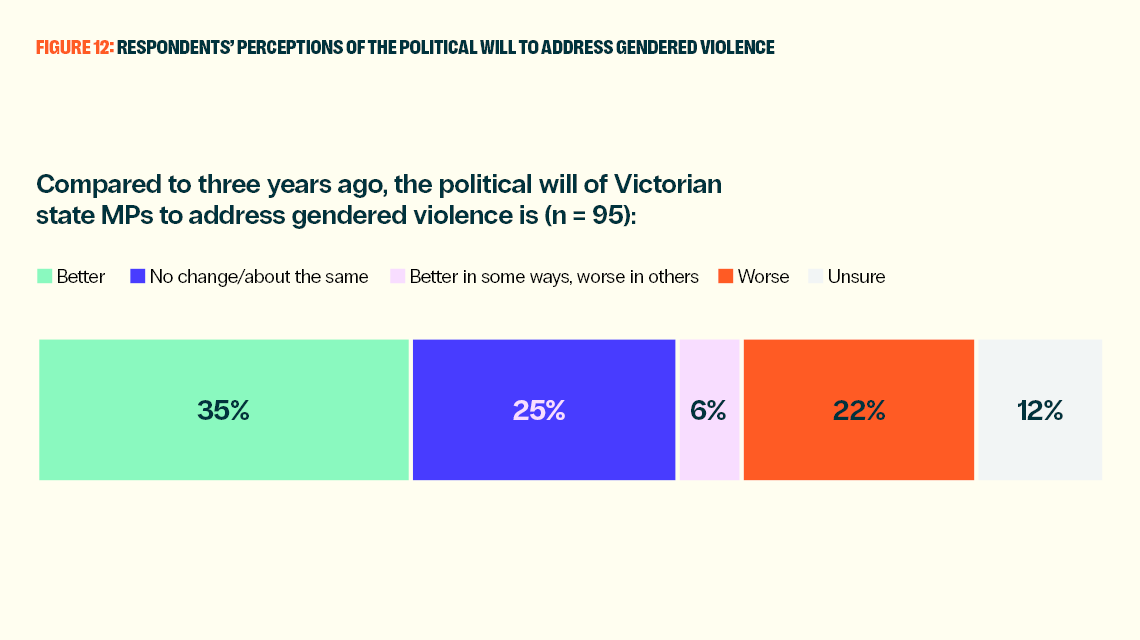
However, just over one-third of respondents surveyed as part of this review reported that the political will to address gendered violence in Victoria is better than it was three years ago.
Where there are challenges
Funding is not commensurate to the problem
Despite welcome investment in prevention in Victoria, the quantum and style of investment have not been commensurate with the scale and complexity of the problem. If we continue along this path, we will continue to see high rates of gendered violence, with some types of violence likely to increase due to escalating online misogyny, homophobia and transphobia.
Report participants noted this and Victoria’s current challenging fiscal environment over the reporting period. In fact, this report period has been marked by funding uncertainty across various government departments, sectors and settings, due to lapsing program funding and short-term funding contracts. Report participants noted this made it challenging to deliver on commitments while strategically planning for future prevention activities. As the reporting period concludes there are several key prevention organisations and programs with lapsing funding.
The goal needs to be that the funding’s always there and that we don’t just get a big push when there is either community engagement or there has been a tragic event or an incident to be able to propel this work forward. That requires so much energy and emotional and cognitive load on the sector to jump when there is this moment, to try to do all the cartwheels to get the funding that we desperately need. It takes us away from actually doing the work to prevent the violence. – Prevention organisation executive
Currently, organisations must stretch limited resources to attempt to meet community need. When prevention initiatives are underfunded, objectives may not be met, projects may not be completed in full, evaluations are often not resourced, and data and outcomes are not able to be robustly measured (2, 106). Report participants noted that many organisations rely on significant volunteer support or unpaid overtime to deliver prevention activity. This is often the case for specialist and community-led prevention organisations, particularly ACCOs, which not only deliver important programs and activities but play a critical leadership role in prevention partnerships and networks to shape and strengthen prevention systems, policy and practice.
Dhelk Dja Koori Caucus and ACCOs have consistently raised issues with the lack of ongoing funding for community prevention projects, the competitive process by which funding is administered, and the need to reapply for funding every year, with successful projects being often pilots rather than funding for existing projects. Funding for Gathering Places is also often limited and not fixed; this means these important places can at times be at risk of closing down. As such, ongoing investment in community-based prevention was highlighted as critical to addressing family violence in addition to focusing on crisis response and support.
Aboriginal women in Victoria are 45 times more likely to experience family violence than other women. This demands a response that is urgent, sustained, and commensurate with the scale of the crisis. This means ongoing investment in specialist, culturally safe, holistic services like Djirra, accessible to Aboriginal women across Victoria. – Antoinette Braybrook AM, Djirra
Taken together, these challenges with the current funding levels limit Victoria’s capacity to implement a comprehensive statewide approach to prevention across all key settings and inclusive of all communities and life stages.
Nature of funding limits prevention efforts
Some funding streams that have been relied upon in the past to progress violence prevention alongside other health, social and economic aims have been rescoped to reduce preventing violence as a priority. For example, the Community Health Integrated Program guidelines only include up to 30% of resources to be allocated to violence prevention, regardless of community priorities and the links between gendered violence and chronic disease, mental ill health, and disability. This limits the resources that community health services can access to do prevention work. Report participants expressed a need for more flexible, long-term funding models that enable organisations to sustain effective prevention partnerships, initiatives and programs, and scale them within and across communities to achieve greater impact – a call mirrored in contemporary research and reviews (2, 11, 28, 107).
Flexibility in the funding model is important; it isn’t a one size fits all. I get that there needs to be clear accountability around acquittals and things of that nature, but I think sometimes you’ve got to be able to allow for some flexibility to cater for the nuances of the communities that are here in Victoria – Vivienne Nguyen AM, Victorian Multicultural Commission
Short-term funding models have long been an issue for prevention work and was highlighted in the first Three Yearly Report. The impact of project-based or short-term funding on sector capacity, the stability of the workforce, and the continuity and effectiveness of prevention programs and initiatives is significant (2). Since findings from the Royal Commission into Family Violence were handed down, these concerns have been consistently reported in program evaluations, reviews and other reports (3, 108-110). Report participants highlighted the consequences of unstable and uncertain funding, including:
- high staff turnover and loss of skills and expertise from organisations and programs
- disruptions to program implementation and community engagement
- lack of time to build and sustain relationships and trust with communities
- difficulty evaluating or demonstrating evidence, outcomes and impact within short timeframes
- time and resources being diverted away from the work to bid for new or renewed funding.
Family Safety Victoria has made important progress in moving a number of programs in key settings to longer-term funding arrangements (i.e. from one- or two-year timeframes to three- or four-year funding contracts), which can continue to be built upon.
Opportunities for action
Rethinking funding models for sustainability and impact
Victoria has a history of socially progressive, sustainable funding models when it comes to preventing large-scale public health issues. The Transport Accident Commission, for instance, is a state-owned enterprise that draws commercial revenue from insurance and can also sustain funding through income generated on reserves. The result has been an entity that supports statewide, coordinated efforts to prevent road traffic accidents and increase road safety. Another example is VicHealth, the world’s first health promotion foundation. Established following the passing of the Tobacco Act 1987 (Vic), the state-owned enterprise coordinates, supports and implements public health initiatives across Victoria to support a healthier state. The Transport Accident Commission and VicHealth models of hypothecated funding provide lessons and opportunities to recast the way prevention of gendered violence, family violence and all forms of violence against women is funded for sustainability and greater impact. Victoria could be world-leading by applying such a model of commercial revenue generation to the prevention of family and gendered violence.
Alternatively, Victoria could consider an analogous model to the ACT Government’s Safer Families Levy, which has been in place since 2016 and is utilised to support the territory’s response to domestic, family and sexual violence, in recognition that preventing violence is a whole-of-community responsibility (footnote 4). A secure ongoing revenue stream would create efficiencies for government and community, minimising the administrative burden of continual budget bids and associated processes and freeing up greater resources to flow directly towards community outcomes.
Identifying and leveraging co-funding and investment opportunities
Opportunities exist to leverage other co-investment opportunities and work towards a true whole-of-community approach to prevention. This includes co-investment from state and national funding schemes with aligned policy goals, such as mental health, community safety and workplace reform, as well as from philanthropy and the private sector. Victoria’s health and medical research capabilities have been progressed significantly through co-investment opportunities between government, universities, the private sector and philanthropy, providing opportunities to explore how a similar model may work for primary prevention (footnote 5).
The Early Intervention Investment Framework (EIIF) demonstrates the Victorian Government’s commitment to investing in preventative interventions that reduce more significant downstream costs for government. The EIIF applies an avoided costs methodology to early intervention program proposals, leveraging access to data linkage of Victorian services and population-level data to estimate and report on the return on investment. While designed for early intervention, the EIIF is embedded in annual budget processes and has unlocked considerable investment to scale up innovative social change projects that support community wellbeing, including those with longer impact horizons, this is comparable to timeframes for some primary prevention initiatives (e.g. 10–20 years). For example, under the EIIF, the 2024–25 State Budget committed $1.1 billion over five years for 28 initiatives, including supporting schools to implement respectful relationships education (111).
The EIIF’s requirement to calculate and track avoided costs creates challenges for primary prevention work due to limitations in data availability and the complexities in establishing causal connections to long-term prevention outcomes. The framework is also limited in its ability to account for growing demand pressures on the family violence system, some of which are driven by global factors. This can distort the extent to which avoided costs mean that less would need to be invested in the family violence system in the long term. Noting these challenges, there is merit in considering a similar funding approach for primary prevention that builds on and expands upon the EIIF. This is because primary prevention – like early intervention – is a powerful way to avoid harm and the costs associated with that harm, delivering strong economic benefits. In 2025, the Victorian Government estimated that its investment of $82.8 million in family and sexual violence systems will save $120 million to $130 million over 10 years in avoided costs, and it will produce up to $140 million through economic benefits over the same period (112).
Recognising the devastating health and mental health impacts of gendered violence may also open up other funding opportunities. Research by Jesuit Social Services and Respect Victoria shows that attitudes and beliefs that drive gendered violence are also associated with poorer mental health in men and boys, including suicide and suicidality (95). Intimate partner violence is a leading, preventable contributor to death, injury and illness for women aged 15–44 years, including mental ill health and trauma (113, 114). Moreover, mental health and trauma informed therapeutic services are an important part of the prevention continuum – they are key to healing and recovering from violence and, in doing so, breaking intergenerational cycles of violence.
Given these recognised links, there are opportunities to draw on revenue generated through the Medicare levy and Mental Health and Wellbeing Surcharge to support prevention initiatives that address both mental ill health and the gendered drivers of violence to simultaneously reduce distress and suicide rates for men and prevent violence, trauma and associated mental ill health among women, children and gender diverse people (115). Victoria’s Mental Health and Wellbeing Surcharge fund generated $1,017.60 million in revenue in 2023–24 and has been increasing year-on-year (116). Victoria also receives a considerable sum each year through the Medicare levy.
There are opportunities to move towards a true whole-of-community approach to prevention, including through leveraging funds from a more diverse range of sources in the private and philanthropic sectors. The private and philanthropic sectors are well placed to support prevention efforts through funding pilots, place-based partnerships, and initial scaling that would enable organisations and communities to trial new approaches, embed community self-determination, and test implementation models across communities and settings to define programmatic and contextual elements of success. These benefits, enabled through private and philanthropic funding, not only support communities and organisations to generate the requisite evidence to secure ongoing government funding to scale and sustain promising work, they also demonstrate proof of concept for further private and philanthropic investment.
The private sector also has a vested interest in leading and embedding prevention efforts within business, industry and key settings. Compliance with key gender equality, human rights, and workplace health and safety requirements is not only a positive duty required of employers, these efforts also result in greater productivity and reputational benefits from having safer, more equal and inclusive workplaces.
Funding pilots and scaling opportunities based on impact
Notwithstanding the challenging fiscal environment of the last three years, the Victorian Government has demonstrated ongoing commitment to primary prevention – most notably through its landmark investment in Respect Ballarat. This is the first time an approach of this kind has been resourced and supported at this level.
Evidence suggests it takes more than five years of sustained work across the social ecology to see population-level positive impacts for prevention work (4, 63). However, government funding cycles are typically between one and four years, limiting capacity to demonstrate long-term impact (96). There is an opportunity to rethink the prevention funding mix to support development of small-scale promising practice approaches, which can form a pipeline of opportunities to scale up. There are also approaches that already have sufficient evidence to show impact that should have longer-term, larger funding amounts to support population-level impacts. Place-based models are particularly important in this sense. Victoria has a long and successful history in place-based approaches to public health issues, such as through VicHealth’s Generating Equality and Respect and Healthy Together Victoria, as well as Stronger Places, Stronger People in Mildura, and Mental Health and Wellbeing Locals across Victoria (117-120). Respect Ballarat will provide important further lessons for how such a place-based model can work to prevent gendered violence and the required funding mix and quantum.
A true whole-of-community approach to prevention requires action and commitment from governments at every level. Importantly, this includes local government. Many local governments invest in prevention initiatives from a broad commitment to addressing gendered violence alongside Gender Equality Act compliance requirements, despite less than half of all Victorian councils receiving funding to do so. Ongoing funding and recognition is required to sustain this work, with contribution and ownership from both state and local government revenue streams. These programs, and similarly those offered by women’s health services, are contributing to effective prevention efforts and adding to the knowledge base of what works in preventing violence in our communities. There is opportunity to build upon this evidence base, to disseminate learnings and reproduce effective modalities across Victoria – and now through its 4 year investment in Respect Ballarat. The coordination of the Municipal Association of Victoria and the Women’s Health Services Network together with Respect Victoria is a critical enabler to do so.
Building the economic case for prevention
Report participants emphasised the importance of continuing to build the economic case for prevention, including through cost-benefit and return on investment analysis.
The Women’s Health Services Network report Return on Equity: Health and economic dividends from investing in Women’s Health Services estimated that in 2023, as 22,000 fewer women experienced physical and/or sexual violence each year than the national average, the associated economic cost savings of this equated to $600 million a year, or almost $8 billion over a lifetime (26).
There is already economic modelling (footnote 6) that can be built upon to develop a fulsome contemporary economic case for prevention, and in doing this, current and future Victorian governments will have a better understanding of the economic and social benefits of prevention activities across portfolios and agencies. Building this economic case will also provide an overview of where government agencies and departments can work together to leverage (and, where appropriate, combine) investment and efforts – for example, across treasury, health, justice, housing, education, workplace reform and child protection portfolios among others.
Recommendations
Respect Victoria recommends that the Victorian Government:
- Publish updated and comprehensive modelling on the cost of family violence and gendered violence to the Victorian economy and community as well as economic modelling on the return on investment for prevention every five years.
- Provide dedicated and enduring funding for primary prevention. This includes:
- identifying and leveraging funding sources and approaches to prevention that promote coordination and sustainability
- supporting long-term (i.e. five years minimum) and/or recurrent, secure, flexible and fit-for-purpose funding models that enable sustained impact
- implementing funding for scaling up promising practice and investment in tried-and-tested successful models, particularly place-based approaches to prevention
- ensuring grant guidelines and eligibility for funding streams across government for health promotion and preventing social issues are inclusive of approaches towards primary prevention of family and gendered violence
- identifying and leveraging opportunities for cross-portfolio funding sources for primary prevention where there are shared benefits and outcomes (such as the Medicare levy and/or Mental Health and Wellbeing Surcharge fund and/or through tailored application or adaptation of the Early Intervention Investment Framework), and exploring hypothecated funding approach for sustainability
- continuing to facilitate funding arrangements that support community-led and targeted prevention with priority communities (including work led by and for First Nations communities, LGBTIQA+ communities, culturally and racially marginalised people, people with disability, children and young people, and older Victorians) including through resourced partnerships with mainstream organisations
- exploring and leveraging opportunities for complementary funding from non-government sources, as part of a mutually reinforcing whole-of-community approach to primary prevention.
Footnotes
It is not possible to calculate a precise amount due to funding periods not overlapping precisely with the reporting period for this report and some integration of preventing funding with broader family violence funding. This estimate has been drawn from publicly available information (predominantly state budget papers) and verified with Family Safety Victoria.
For example, a number of organisations that had previously been on one-or-two year funding cycles moved to three-or-four-year funding agreements under the Statewide Prevention Workforce Development Program (2022-2026), the Women's Health Services Capacity Building Project (2022-2026), the Free from Violence Local Government Program (2022-2025), and the Gender and Disability Workforce Development Program (2023-2027).
Additional funding was provided in 2025 to continue this project after the reporting period.
The ACT Government's Safer Families Levy is currently $50 per household and is estimated to generate $30 million over four years. Further information can be found at www.revenue.act.gov.au/levies/safer-families-levy
See, for example, the Australian Institute for Infectious Disease (AIID) an initiative of the University of Melbourne, the Doherty Institute and the Burnet Institute with co-investment from the Victorian Government. Futher details available at aiid.edu.au
For example, modelling by KPMG and Deloitte referred to earlier, outlined in recommendation 1, updated modelling is now required to busiess support the case for ongoing and scaled up, prevention investment.