

On this page
This section aligns with the following domain of the Theory of Change:
- 1.5 Quality programs
- 1.6 Partnerships and collaborations
- 1.7 Programs are inclusive
Community-led organisations are an integral part of the prevention landscape. They not only lead and deliver prevention programs and activities tailored by and for specific communities, they also have a key role in driving policy and systems change, practice development, and building the capability of mainstream prevention organisations and practitioners to embed safe, inclusive and intersectional prevention practices (11, 181).
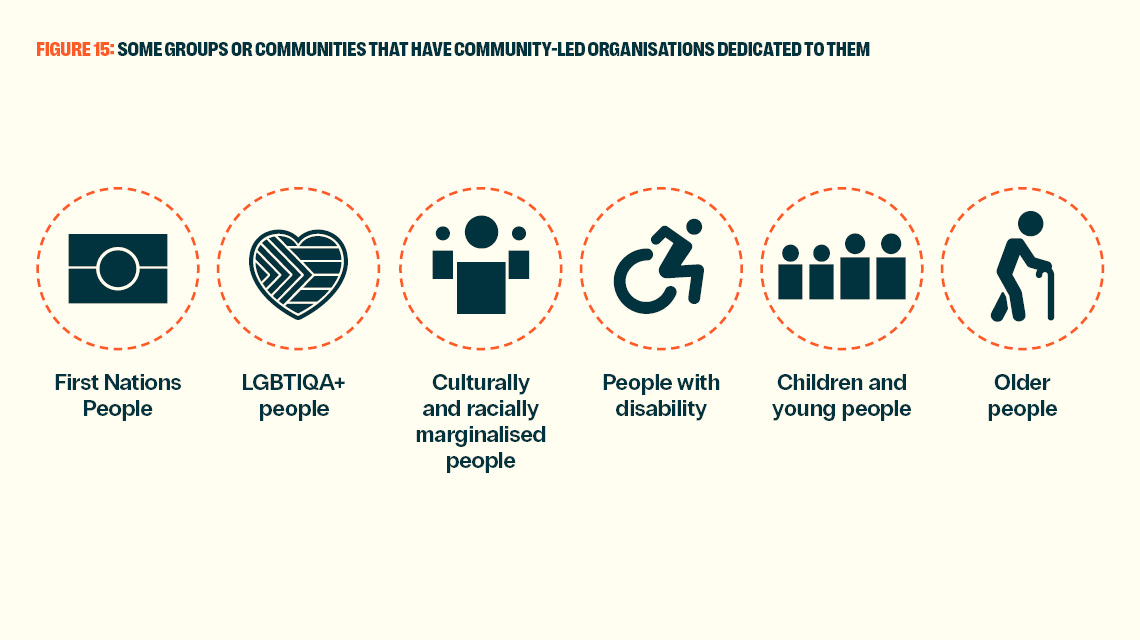
Community-led organisations also have well-established and trusting relationships with the communities they serve. This means they are ideally placed to effectively engage their communities to design and deliver prevention programs and activities that are appropriate, relevant and impactful. In the context of this report, community-led organisations are those led by and for specific groups or communities, including those outlined in Figure 15.
Where progress has been made
Government support for community-led work
The Victorian Government had a more explicit focus on community-led prevention work over this reporting period, funding several community-led programs and initiatives including the Supporting Multicultural and Faith Communities to Prevent Family Violence Program, the LGBTIQ Family Violence Prevention Project, the Gender and Disability Workforce Development Program and the ‘Raising awareness of elder abuse in ethnic communities’ project.
They also continued to support the Dhelk Dja Partnership Forum and its critical role driving the implementation of Dhelk Dja: Safe Our Way – Strong Culture, Strong Peoples, Strong Families, and they funded several Aboriginal-led prevention projects through the Community Initiatives Fund.
Older people
Since 2023, the Victorian Government funded Celebrate Ageing, a charity combating ageism and building respect for older people, to lead a community of practice for the eight elder abuse prevention networks. Members of the networks include local councils, community legal centres, aged care providers and many others. The project has built the capacity of network leads to deliver primary prevention action with larger scale and engagement, strengthen partnerships and improve outcome evaluation approaches.
The conclusion of the Commissioner for Senior Victorians role in May 2023 closed an important avenue for the voices and experiences of older Victorians to be heard and integrated across state government priorities, including violence prevention. The Senior Victorians Advisory Committee, including community and sector members advising the Minister for Ageing, was established in December 2024 and is a voice to the government on the lived experiences of older Victorians. The committee’s workplan includes a focus on elder abuse, including prevention. Engagement with advocacy organisations supporting and advocating for older people – including the Council on the Ageing Victoria – offers an opportunity to better reflect their experiences in prevention work.
Children and young people
The Supporting Young People to Understand Affirmative Consent Program was funded from 2022 to 2025 by the Victorian Government as a response to the implementation of the new affirmative consent model in Victoria. The program supported 12 projects to test and trial approaches to engaging with young people and their key influencers, to improve knowledge on affirmative consent. Projects applied a variety of youth co-designed approaches including workshops, peer-to-peer education models and the development of digital and multimedia resources. The program complemented the Respectful Relationships program delivered in Victorian schools, ensuring young people received consistent and reinforcing messages about affirmative consent and healthy relationships.
It has also been incredibly important and welcomed to see the advocacy of young people with lived experience of childhood violence and trauma become powerful advocates for the rights and needs of children and young people – for example, advocacy of young leaders such as Conor Pall in Victoria and Grace Tame, Chanel Contos, the Teach Us Consent organisation and many others nationally. During this reporting period, advocates representing children and young people have been part of state and national conversations to address violence, including as part of the Rapid Review of Prevention Approaches, within the Victim Survivors’ Advisory Council and several national roundtables.
Recognition of deep expertise and sector leadership
Report participants widely acknowledged the deep prevention expertise and capabilities of community-led organisations. They also emphasised the important leadership role community-led organisations play in guiding and driving more inclusive and responsive prevention policy and practice that recognises and addresses the drivers of violence against their communities.
People with disability
The Gender and Disability Workforce Development Program was established in this reporting period, seeking to build capability in this sector on prevention of violence against women with disabilities. The program developed a suite of resources including some with a focus on deepening understanding of the intersection of race, gender and disability (182).
Organisations like ours, Women with Disabilities Victoria, Rainbow Health [Australia] – where you’ve got specific cohorts that are particularly vulnerable to gendered violence and also need a specialist approach to prevention … are really well positioned to provide that specialist approach. – Adele Murdolo, Multicultural Centre for Women’s Health
Women with Disabilities Victoria also partnered with both Respect Victoria and Our Watch in this period. Our Watch and Women with Disabilities Victoria developed new resources to support primary prevention organisations and professionals working with people with disabilities. Respect Victoria and Women with Disabilities Victoria worked together on a campaign – Agency, Access, Action – find more details.
Aboriginal communities
The Dhelk Dja Koori Caucus worked with the Victorian Government to review and refine the Indigenous Family Violence Primary Prevention Framework (first developed in 2012) to ensure it reflects Aboriginal ways of knowing, being and doing, and places Aboriginal leadership at the centre of long-term, systemic change. In addition, ACCOs continued their long history of developing and delivering culturally appropriate family violence prevention programs.
Importantly, Aboriginal-led prevention approaches are some of the best examples of integrated prevention in Victoria. There is significant opportunity for the broader prevention sector to learn from Aboriginal-led prevention through stronger partnerships and collaboration with ACCOs, the Dhelk Dja Koori Caucus and its Regional Action Groups.

LGBTIQA+ communities
Throughout the reporting period, the LGBTIQA+ Family Violence Primary Prevention Project has made great strides in increasing recognition of and prioritising violence against LGBTIQA+ communities in primary prevention work. Numerous resources have been developed including the Pride in Prevention Evidence Guide, Messaging Guide, Partnership Guide and Evaluation Guide (9, 183-186). This nationally and internationally significant work emphasised and acknowledged the shared drivers of violence against both women and LGBTIQA+ communities, and the ways in which efforts to prevent both types of violence are – and must be – intrinsically linked.
Several strategic partnerships were established and strengthened during the reporting period, with the aim of progressing intersectional prevention practice inclusive of LGBTIQA+ people, deepening understanding of the shared and overlapping drivers and goals of preventing violence against women and LGBTIQA+ people and building genuine allyship across the sector. This includes Our Watch partnering with Rainbow Health Australia to develop a national framework to prevent violence against LGBTIQA+ people and communities, which builds on the evidence and good practice already established through Pride and Prevention.
Zoe Belle Gender Collective also partnered with Women’s Health in the North to support capacity building within women’s health agencies, and this important work is now being modelled across the sector (see case study below).
Culturally and racially marginalised communities
Report participants from organisations that serve multicultural, refugee and migrant communities advised about the importance of their work in upskilling and supporting mainstream organisations. These organisations ensure that prevention work accurately reflects the diversity of the community. This work often happens through strategic partnerships, for example, between Multicultural Centre for Women’s Health and Safe and Equal in the ‘Connecting Communities: Improving our approach to community-led prevention’ program (187). This initiative produced several different resources, as seen below.
Where there are challenges
Resourcing community-led work
Report participants stated that despite the increasing recognition and support for community-led prevention work, the amount and structure of funding available creates resource burdens for community-led organisations, impacting their capacity to deliver community-oriented work. They noted that funding streams and grants are often insufficient, insecure and too short-term to sustain programs and activities for long enough to demonstrate their outcomes and impact.
Community-led organisations are often called on to support the development and implementation of government policy and sector-wide frameworks, but without additional funding to support their involvement and contribution. As such, their funding needs to reflect the resources required to support this strategic uplift across the entire sector.
Supporting system-wide capability building
Community-led organisations play a critical role in workforce capability building across the system, including by delivering training and other professional development activities; developing practice frameworks, tools and resources; and contributing to a range of practitioner networks and communities of practice. Several community-led organisations in Victoria were funded to deliver workforce development programs or communities of practice over the reporting period, including Women with Disabilities Victoria, Rainbow Health Australia and the Multicultural Centre for Women’s Health. However, there are opportunities to ensure this work is adequately resourced, so organisations are able meet significant levels of demand for the specialised training and support they provide.
The costs of partnering
Participation in prevention networks and partnerships is important, yet community organisations are often not adequately remunerated for their participation. For small organisations, participation in this context reduces their capacity to deliver other services and programs. This is particularly challenging for community-led organisations that are asked to contribute to multiple partnerships and committees to deepen intersectional practice and ensure representation. This forces organisations to choose between representing their community but reducing resources or maintaining their resources for community-oriented work but not being represented in important collaborative spaces.
When you are working with marginalised communities that are already really stretched, you need to make time and resources available for that. – Julie Kun, Women with Disabilities Victoria
Victorian prevention grant opportunities encourage partnership because of the benefits to practice, but participants in this review noted that funding is often not reflective of the contribution community-led organisations make. Funding models and prescriptive grant criteria can limit the ability of community-led organisations to apply, given their work often involves self-determined approaches that are more effective and/or culturally safe yet do not neatly match mainstream criteria – for example, programs that integrate primary prevention, early intervention, response and recovery approaches.
How are we all ensuring that no communities are left behind in our response to gendered violence? I think we need more peer-led community-based programs representing a diverse range of communities, including First Nations trans women and trans women of colour. – Starlady, Zoe Belle Gender Collective
In the current social and political context of increased homophobia, biphobia, transphobia and transmisogyny, it is particularly crucial that LGBTIQA+ community-led organisations such as Rainbow Health Australia and Zoe Belle Gender Collective are supported to actively participate in existing partnerships across government and prevention-focused organisations to grow practice that is inclusive of and responsive to LGBTIQA+ and transgender people, in particular.
Meaningful and equitable engagement
Report participants reflected that prevention work being delivered by community-led organisations can sometimes be rendered invisible. This can happen through a lack of recognition for work that does not align with dominant frameworks and evidence-based models of prevention, tokenistic and/or extractive engagement, or unequal power dynamics in partnership work.
There’s willingness ... [but we need] that proactive approach from broad major organisations to recognise the role of community organisations and be willing to work with them, and build their [own] capacity to actually have an equitable partnership – Vivienne Nguyen AM, Victorian Multicultural Commission
Recognising and enabling community-led prevention work should be prioritised as an integral part of prevention system strengthening work, including in policy development, practice leadership, evidence-building, workforce development and capability building of the sector more broadly. This requires adequate funding for strategic partnerships and collaboration between peak bodies, specialist prevention organisations, community-led organisations, and grassroots or peer-led organisations. It also requires consistent recognition that prevention is not truly whole-of-population unless it meaningfully acknowledges and engages with the diversity within Victorian communities and their distinct experiences.
While organisational engagement is important, the voices of individuals themselves are essential to create representative prevention work. For example, while there are organisations that represent the interests of children and young people (including the Centre for Excellence in Child and Family Welfare and the Commission for Children and Young People) and groups which include the voices of young people (such as the Victim Survivors’ Advisory Council and Berry Street’s Y-Change), opportunities to directly include and promote the unique voices and perspectives of children and young people within prevention policy, design and delivery can be strengthened.
Aboriginal-led prevention
The Dhelk Dja Koori Caucus and ACCOs consulted as part of this report highlighted the urgent need for greater government accountability and investment in Aboriginal-led prevention.
Lapsing and insecure funding continues to undermine Aboriginal-led prevention initiatives. Without long-term investment, successful projects are left vulnerable, staff and community trust are lost, and momentum for change is stalled. Funding cycles need to align with the long-term vision for prevention – Dhelk Dja Koori Caucus
They noted the importance of government upholding the principle of Aboriginal self-determination and supporting ACCOs to lead and determine priorities and approaches based on their communities’ needs (17). This includes providing secure, long-term funding to enable ACCOs to deliver prevention work in flexible, culturally safe and impactful ways.
A number of report participants called for the government to recognise the holistic and integrated approach of Aboriginal-led prevention, and the importance of initiatives that address the intersection of gender inequality, race and colonisation as drivers of violence against Aboriginal people. Commitment to implementing the forthcoming refreshed Aboriginal Family Violence Primary Prevention Framework, including through Dhelk Dja Regional Action Plans, would significantly support these steps. Dhelk Dja Koori Caucus also called for formal agreements between the prevention sector and the caucus to support engagement with Aboriginal community to design, deliver and evaluate prevention activities.
The release of the Yoorrook Justice Commission’s recommendations related to family violence also set out a clear agenda for action, and mirrored feedback from report participants. The commission recommended the establishment of a First Peoples prevention of family violence peak body and greater investment in primary prevention and early intervention that addresses the intersection of racism and family violence. The commission also recommended that the Victorian Government provide sustainable, long-term funding to ACCOs to expand their specialist family violence services and establish First Peoples Women’s Centres for First Peoples women affected by family violence (188). (See Djirra’s Koori Women’s Place case study.)
Opportunities for action
Investment in Aboriginal-led prevention
Long-term investment in First Nations–led prevention is critical to self-determination and effective action. ACCOs bring deep expertise and cultural safety to this work, yet they have received unpredictable and short-term funding for many years. ACCOs working in this space must be well resourced to lead prevention in their communities, and to participate in governance and leadership across the sector.
Investment in community-led organisations as critical prevention infrastructure
Ongoing strengthening of the prevention system will require that specialist, community-led organisations are adequately and sustainably funded. This will support their critical leadership role driving policy and systems change, building the capability of prevention practitioners to embed safe and inclusive practices and content for marginalised communities, and addressing the shared and unique drivers of violence against marginalised communities. At a minimum, this should include funding to support their participation in government and sector partnership groups and networks, and the delivery of workforce development activities.
Meaningful engagement of marginalised communities
Prevention efforts must be inclusive, representative and community-led to prevent family violence, violence against women and gendered violence effectively and equitably. The meaningful engagement of marginalised and under-represented groups strengthens the relevance, safety and impact of prevention initiatives and reduces the likelihood of unintended negative consequences. It is also crucial for accelerating progress towards a violence-free society, given marginalised groups often experience higher rates of violence. To make this possible, community engagement must be adequately resourced and remunerated to ensure it is ethical, sustainable and not extractive. It is also important to ensure equity in partnerships between larger organisations with higher levels of funding and smaller community-led organisations.
Uncertain and fixed-term funding results in reduced capacity of marginalised communities and community-led organisations to engage with the prevention sector, and the cessation of promising programs. Well-resourced organisations can progress prevention with their communities and build capacity in the wider sector to use inclusive practice.
Recommendations
Respect Victoria recommends that the Victorian Government (footnote one):
- Require, remunerate and resource inclusion of the perspectives and priorities of marginalised communities and under-represented voices in relevant government-funded prevention policy and program design. This includes, but is not limited to the following communities and the specialist organisations that represent them:
- children and young people
- LGBTIQA+ communities, in particular trans and gender diverse people
- culturally and racially marginalised people
- people with disability
- First Nations communities
- older Victorians.
- Guarantee long-term funding for First Nations led prevention work to address disproportionate rates of family violence and support self-determined prevention activity. This should include resourcing to enable specialist Aboriginal Community Controlled Organisations to realise Indigenous Data Sovereignty and participate in sector governance and leadership.