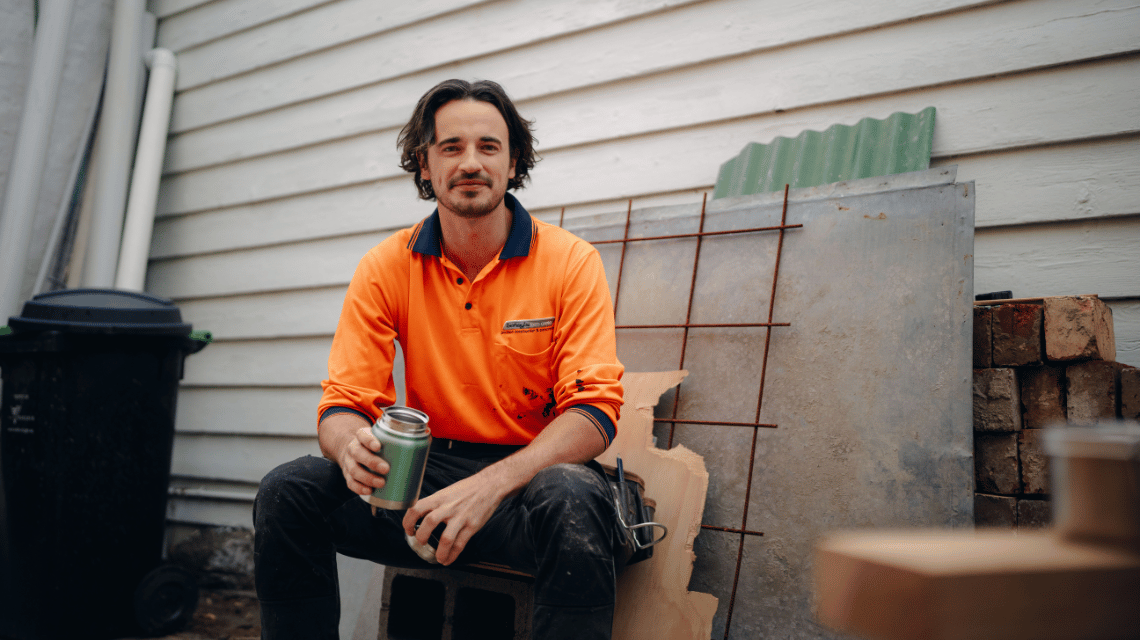
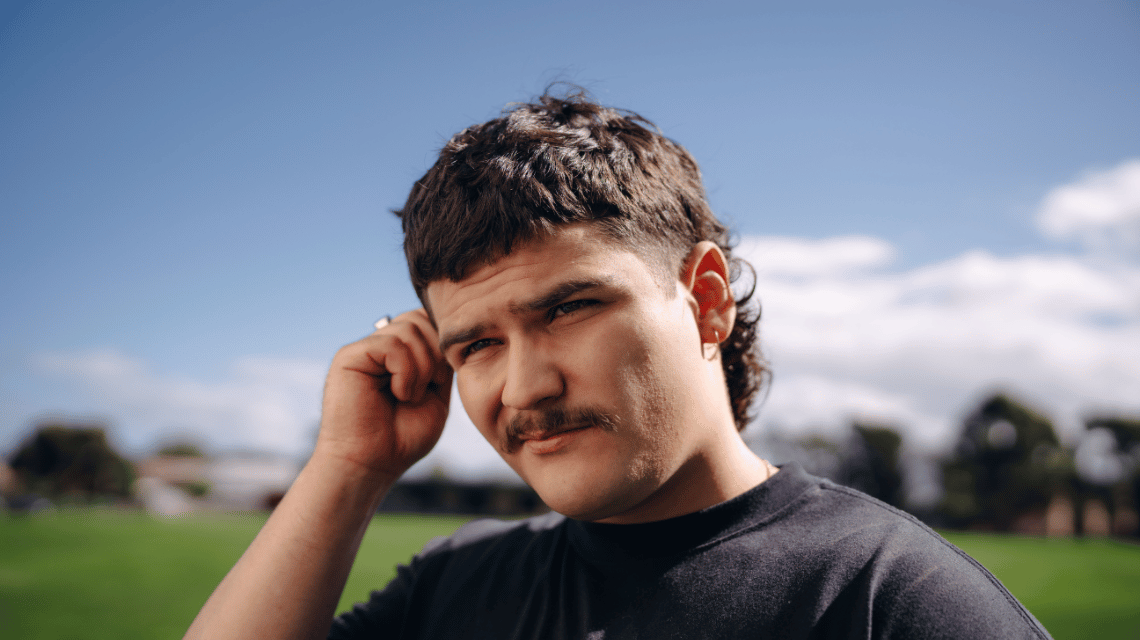
We had a chat with Katen about the culture at his local footy club and how it influenced his idea of what it means to be a man. He's seen mates try to improve themselves online, who've wound up caught up in a stream of hate.
In conversation with Katen
My name’s Katen. I grew up and live in Footscray. I study youth work and criminal justice, and I work at the Western Bulldogs helping run a Koorie youth leadership program.
Growing up, what pressures did you see around masculinity and “being a man”?
It starts early. You watch your dad, your friends’ dads, older boys, older teammates. That becomes your first reference point for what “being a man” looks like. But it ramps up in the early teen years. When you’re a kid, there’s a bit of ignorance. You’re not always carrying those pressures. Then you hit adolescence and you start seeing yourself compared to society. Footy clubs and sport were a big part of that. You’re on an under-12 team, but you’re watching the seniors. How they talk, how they act, what gets respected. In high school, the age gaps feel massive too. In Year 7, Year 12s looked like 40-year-old men to me!
What were some of the traits you learned were “manly”?
Leadership, confidence, but not arrogance. Humility, strength, bravery, fearlessness. Being in control. I could see that’s what was represented. But my personal experience showed me there isn’t one way to be a man.
Where did you see the negative side of that culture?
Footy clubs, especially in the early teen years. Even though it’s a team sport, there can be tension. An alpha/ego dynamic. You’d see bigger, stronger boys act like they were better than everyone. And there was “jovial bullying”. You know, taking the piss. But there are levels to it, and it can go too far. I remember being smaller and not the best at footy. Sometimes people would put me down in a group to show off. And I saw whole teams gang up on one kid because he was skinnier, or shorter, or heavier. And the expectation was you just smile and laugh along.
Even on the receiving end, you don’t want to show it hurts. So you either mouth off back, or you just cop it and act like it doesn’t affect you.
What did you notice about how blokes talked about women?
It depends who you’re around. At home I was lucky. My dad’s fairly progressive. But at footy clubs, you’d see it. I remember an away-team parent yelling at umpires: “This isn’t netball!” using a women’s sport as a way to call something soft. A lot of it is so ingrained that even if guys don’t consciously acknowledge it, there’s this hierarchy where women are treated as inferior, like they’re objects, they’re not even people. And it’s confronting, especially when those same guys have sisters and mums. I don’t know how you don’t imagine someone talking like that about the women in your life.
Why is it so easy for some men to disconnect like that?
Because they end up in groups that enable it. Or there’s pressure. You hear people talk like that and you do the weak thing: go along with it to fit in, to look cooler, even though part of you knows it’s not right. That’s the irony: going along with it is the weaker option. Standing your ground is harder.
Have you ever called someone out?
Yeah, and there are also times I didn’t, and I reflect on that. One time in high school, someone used a sexist slur about my girlfriend. I confronted him and made him apologise. But afterwards I questioned myself: did I do it because what he said was wrong or because I felt insecure, like I couldn’t let someone talk about my partner that way? Did I do it to do the right thing, or to protect my pride? That reflection mattered because you want your heart in the right place. Sometimes “making yourself feel good” isn’t the path. And even his apology was telling: it wasn’t “I shouldn’t say that about women.” It was more like “I shouldn’t have said it about her,” like it might be fine to use about someone else. That’s not accountability.
What’s it like being a young man with social media everywhere?
It’s freaky. Society’s changing. There’s more awareness of what women experience, more challenge to power. And when you challenge people in power, they push back. Online gives people endless space to push back against equality and that often becomes anti-women, anti-trans, anti-gay, anti-Blak, whatever the target is. What’s scary is how it’s packaged: the same creators will mix “self-help” and “motivation” with hate. So young men get sucked in through “be better, be successful,” and suddenly it’s “control women,” “don’t let your partner have Instagram,” “women should do X.” It can start “normal” and slide into radicalisation quickly.
Have you seen mates fall into those rabbit holes?
Yes. Friends or family liking or following creators who are basically peddling hate. Often it comes from ignorance and a lack of understanding. I’ve also noticed there can be other things going on in their lives. Family stuff, friendship stuff, trauma. And the online space becomes refuge, somewhere they feel seen.
How do you stop yourself getting pulled into it?
Check the whole account, not just one post. A meme might look like “ironically offensive dark humour.” But if you go to their page and every post is punching down at the same groups, you realise there’s an agenda. Memes are powerful because irony gives plausible deniability: “It’s just a joke.” But sometimes it’s not.
How do you respond when someone you know is deep in it?
I try to start from understanding, not judgement, and have the conversation: where is this coming from, what does it mean to you? But also: it’s not always your job to save someone. If they don’t want to change, you can pour energy into a strained relationship and nothing shifts. It depends. If someone is actively reposting hate, that might be a line: that’s not someone I want around me. If it’s someone you love, you might try harder. But some things you just can’t get behind.
How did you get to this level of self-awareness?
My parents are fairly staunch in their values (my sister too!). My school was quite progressive. There were people willing to call out behaviour and hold men accountable. And I learned through reflection. Watching others reflect, then applying it to myself: what I say, what I do, what it means, what sits behind it.
What advice would you give your younger self?
Be more self-aware. Take a step back. Think before you do something, before you post, comment, or say something. Ask: who does this affect? How does it come across? Take that second, and take accountability if you need to.
If the pressures of masculinity didn’t exist, what would life look like for men?
You’d see a lot more diversity in how men act. More relaxed, more easy-going, fewer rules. But I also think some pressure would exist in some form. Social media didn’t create the issue; it just opened a bigger avenue and reaches younger and younger people.
Is there one way to be a man?
No. I’ve had to grapple with that. But the older you get, the more comfortable you become: there isn’t one way to be anything. Strength is speaking up for what’s right, not going along with it just to be cooler or fit in. Masculinity isn’t one-size-fits-all. It’s a choice: intention, respect, accountability. And that choice affects everyone around you.