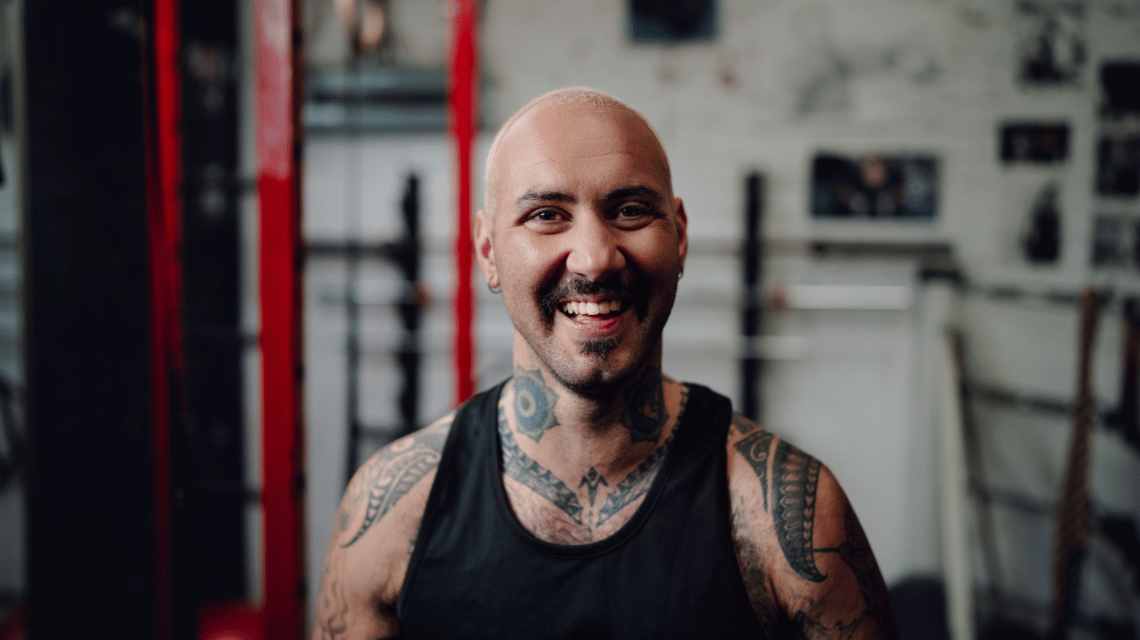
We sat with Fui and talked fatherhood. Fui loves being a dad and has a close relationship with his kids. For Fui, being a ‘strong dad’ is about love, care and connection.
In conversation with Fui
My name’s Patrick, but everyone calls me Fui. I’m in my early 40s, I’m a fitness coach, and I live in Melbourne’s west. I was born in New Zealand to Samoan parents, and we moved to Australia when I was young. I’ve got a wife I owe a lot to, and I’m a dad of five.
What did being a man look like to you growing up?
My dad was a very masculine man. Very strong, disciplined, direct. There wasn’t much grey area. What he said was what he meant. A lot of what I saw as a kid came from TV as well: action heroes, alpha males, men saving the day. The man was always the hero. The women were there to be rescued or admire him. That was the picture of masculinity I grew up with.
How did that idea change as you got older?
As a kid, I believed it. As a young adult, you realise real life doesn’t work like TV. But the biggest shift came when I became a dad. Fatherhood made me question which ideas I grew up with I wanted to keep and which I wanted to leave behind.
How has that shaped your relationship with your kids?
It’s made it better than I ever imagined. My kids are relaxed around me. They talk to me. They come to me with things. Even the awkward stuff. That means everything to me.
What role has your partner played in that journey?
A massive one. My wife is outgoing, energetic, emotionally expressive. She’s the opposite of me. She’s opened my eyes to things I just wasn’t aware of. She’s helped me understand what support looks like from a woman’s perspective. What helps, what hurts, and what really matters in a family. I honestly owe a lot of who I am as a dad and a man to her.
Your family set-up looks different to what you grew up with. Can you talk about that?
Growing up, my dad worked long hours and my mum stayed home. That was all I knew. In our family, it’s flipped. I work part-time and stay home, and my wife is the breadwinner. In our culture, that’s not the usual way things work but it works for us.
Why does that arrangement work for your family?
One of our kids needs extra support, and I’m the one who takes them to appointments and specialist care. Things my wife finds emotionally overwhelming. Being home means I’m present. My kids see me. I spend time with them. I do things with them that I never had growing up. Just being there after school, being available, being involved.
Do you still see yourself as a “masculine” man?
Absolutely. I still see myself as masculine. Just a different version. I’ve kept the good values I learned from my dad, like being organised, reliable and committed to family. But I’ve softened the parts that didn’t serve us. Masculinity doesn’t disappear just because roles change.
What does being a “good man” mean to you now?
Being there. Showing up. Playing your part as a dad and a partner. I always come back to family. That’s my measure.
How did becoming a dad change you?
It changed me completely. I wasn’t expecting to become a dad when I did. At the time, I was a bouncer and a bit of a loose cannon. Fatherhood flipped everything 180 degrees. It forced me to let go of things I thought made me strong, like not showing emotion.
There was a powerful moment with your father later in life. Can you share that?
After we moved back to Melbourne, one night during evening prayer, my dad stopped and said he wanted to say something. He told me he was sorry. That he could have been a better father. That he was proud of the man and the dad I’d become. And that he loved me. That lifted a weight I didn’t even realise I was carrying.
How did that moment change things for you?
It helped me understand how much breaking that cycle mattered. Not just for me, but for generations after me. It showed me that change is possible, even later in life.
What advice would you give first-time dads?
Don’t overthink it. I was a helicopter dad at first. Constantly checking, constantly worrying. Just take it as it comes. Learn as you go.
What kind of man do you hope your kids see when they look at you?
I want them to see someone they can always turn to. I might not be able to solve every problem, but I’ll sit with them and work it out together. If my kids see me as their hero – not because I’m perfect, but because I’m present – then I’ve done my job.